Recommended path
Precision OEM path
Input your 20:1 sourcing constraints to evaluate supplier readiness, then use our evidence report to select the right 2-stage planetary or helical supplier architecture.
A 20:1 ratio is a multi-stage gearbox. The calculator verifies if your lead time, volume, and quality expectations align with standard catalog OEMs or custom programs.
Score whether your 20:1 sourcing constraints are RFQ-ready, compare region baselines, and identify the next executable RFQ action.
Go - RFQ shortlist ready
Supplier path appears feasible for a 20:1 supplier shortlist under current assumptions.
Recommended path
Precision OEM path
Region baseline
China baseline
Readiness score
96.0
Risk level
low
Suggested suppliers
3
NPI estimate
6 weeks
Mass lead baseline
6-14 weeks
Why this result: score blends technical fit, quality evidence, and delivery pressure. Use it as a sourcing gate, not final supplier approval.
Next action
Launch a normalized RFQ to at least three suppliers with one shared duty profile, backlash target, and quality-evidence template.
The prefilled email includes your constraints and computed readiness checkpoints.
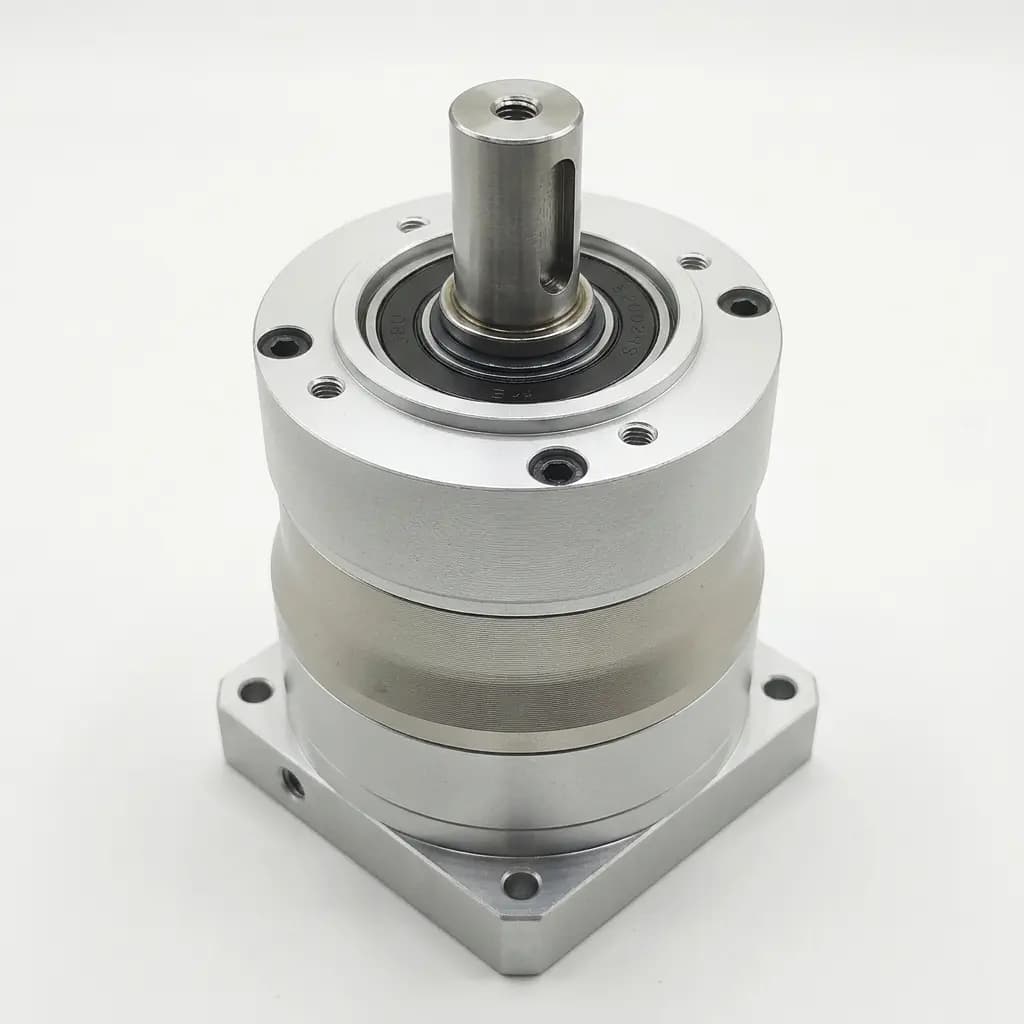
What a 20:1 supplier decision must verify
The visible housing, output bearing support, flange interface, and seal area are not cosmetic details. They define the RFQ checkpoints for envelope fit, radial load, thermal rise, and backlash measurement before supplier award.
This page does not rank suppliers by brand reputation alone. It screens whether a buyer can prove exact 20:1 availability, geometry fit, torque headroom, backlash class, duty limit, and compliance readiness with auditable RFQ evidence.
| Gate | Evidence Required | Reject Boundary |
|---|---|---|
| Ratio proof | Require a public ratio table, current configurator output, or supplier drawing that shows exact 20:1 orderability. | Reject verbal "20:1 available" claims without a current order code and dimensional model. |
| Two-stage geometry | Check the envelope, motor adapter, bearing span, and 4:1 x 5:1 or equivalent stage pairing before fit approval. | Reject single-stage assumptions because they understate length, backlash stack-up, and thermal load. |
| Backlash and torque gate | Score measured backlash class, output torque, peak torque, radial/axial load, and emergency-stop condition together. | Reject selections sized only from motor nominal torque or marketing phrases such as "low backlash". |
| Thermal and duty gate | Ask for S1 continuous-duty thermal data or a temperature-rise test condition tied to lubricant and mounting position. | Reject continuous-duty awards where mechanical torque is the only published limit. |
| Compliance boundary | Screen export classification, destination, end user, end use, and customs paperwork before China-origin award. | Reject blanket assumptions that ratio alone makes a gearbox controlled or routine freight. |
Compare established catalog suppliers and OEM paths for 20:1 ratios. This table helps distinguish public evidence from baseline supplier assumptions.
| Supplier | Architecture | Exact 20:1 Status | Best Used For | Efficiency / Backlash Proof | RFQ Action |
|---|---|---|---|---|---|
Apex Dynamics | AB/AD/AF series inline planetary and right-angle | Public catalog confirms exact 20:1 as a standard 2-stage configuration (alongside 15:1, 25:1). | High-precision servo applications, automation, and robotics | Rated at ≥ 94% efficiency for 2-stage AB series.P0 class ≤ 3 arcmin, P1 ≤ 5 arcmin, P2 ≤ 7 arcmin for 2-stage models.Apex Dynamics AB/ABR catalog data (Last checked July 19, 2026)Open supplier source | Specify required nominal torque, backlash class (e.g. P1), and motor adapter for exact sizing. |
Wittenstein alpha | SP+ inline planetary and right-angle gearboxes | Catalog confirms 20:1 ratio is widely available in their two-stage offerings. | Premium positioning accuracy and high-dynamic servo applications | High efficiency typically 94-95% for 2-stage Advanced Line (SP+).Torsional backlash is typically ≤ 1 to 4 arcmin depending on "Standard" or "Reduced" class.Wittenstein alpha SP+ product specifications (Last checked July 19, 2026)Open supplier source | Use as a high-end benchmark. Verify if your application requires this precision level. |
Neugart | PLE economy and PLN precision planetary gearboxes | Supported as a standard 2-stage ratio (Z=2) across multiple lines. | Cost-sensitive automation where standard precision is sufficient | Rated at ~95% for full-load 2-stage PLE units.Size-dependent: PLE040 < 19 arcmin, PLE080 < 9 arcmin; PLN series offers lower backlash.Neugart PLE catalog and product data (Last checked July 19, 2026)Open supplier source | Compare economy vs precision lines to balance cost against backlash requirements. |
SEW-Eurodrive | F-series parallel-shaft helical gear units | Supported for industrial continuous-duty applications | Conveyors, material handling, heavy continuous-duty torque | High efficiency typical of helical gears (~95-96% across two stages)Standard industrial backlash; generally higher than planetary servo unitsSEW-Eurodrive parallel-shaft helical documentation (Last checked July 19, 2026)Open supplier source | Request a configuration with service factor, thermal rating, and mounting position. |
Custom OEM Suppliers in China/Taiwan | Custom planetary or helical 20:1 reducer assemblies | Feasible via multi-stage pairings (e.g., 4:1 and 5:1 stages) | High-volume production with specific housing or shaft requirements | Dependent on gear quality and bearing setup; generally 90-95%Driven by tooth quality and stage integration (often 8-15 arcmin)Engineering inference from standard multi-stage planetary geometry; validate against supplier drawings and inspection reportsNo public catalog claim assumed; verify by RFQ drawing pack. | Specify duty cycle, peak torque, and request PPAP or inspection reports in the RFQ. |
| Topology | Good Fit | Strengths | Caution | RFQ Focus |
|---|---|---|---|---|
| Two-stage Inline Planetary | Servo applications, robotics, automation axes | High torque density, coaxial input/output, low backlash options | Longer housing than single-stage, ~94% efficiency limit | Continuous torque, peak torque, radial/axial load, backlash limit |
| Right-Angle Bevel-Planetary | Space-constrained AGVs and conveyor drives | Compact footprint, 90-degree motor mounting | Efficiency drops slightly compared to inline; more complex to assemble | Mounting orientation, thermal limit, output shaft style |
| Parallel-Shaft Helical | Continuous-duty industrial drives | High efficiency, very durable for continuous running | Larger footprint, standard backlash may be too high for servo positioning | Service factor, lubrication, mounting position, thermal power |
| Cycloidal / precision cyclo alternative | High-shock indexing or robotics when ratio flexibility is acceptable | Very high shock-load tolerance and very low backlash options are available in some product families | Not an exact 20:1 planetary substitute; ratio set, stiffness, efficiency, cost, and mounting must be confirmed | Accepted ratio window, shock factor, backlash class, stiffness, mounting, budget |
Pass: The drawing shows a 2-stage gearbox and overall length matches your machine envelope.
Fail: You assumed single-stage dimensions and the gearbox does not fit the design.
Pass: Nominal, acceleration, and emergency-stop torques exceed your 20x multiplied motor torque.
Fail: The gearbox is sized only on motor nominal torque, risking failure during e-stop.
Pass: The 2-stage backlash (e.g., <8 arcmin) is within your positioning error budget.
Fail: You expected single-stage backlash (<3 arcmin) but ordered standard 2-stage.
Pass: Supplier published or tested thermal rating covers input speed, duty cycle, lubricant, seal material, and mounting position.
Fail: Selection uses only mechanical torque while ignoring heat from high input speed and continuous duty.
Pass: Supplier or logistics review confirms export classification, destination, end user, and end use documentation before shipment.
Fail: You treat a China-origin precision reducer as routine freight without export-control and customs screening.
Common questions about procuring 20:1 gearboxes.
For high-precision servo applications, Wittenstein or Apex Dynamics are benchmarks. For economy automation, Neugart is a strong option. For heavy continuous industrial duty, SEW-Eurodrive helical reducers excel.
No. Single-stage planetary gearboxes typically max out at a 10:1 ratio. A 20:1 ratio requires a two-stage configuration.
If you have high volumes, require a custom housing or shaft, and have a structured PPAP quality process, China or Taiwan suppliers offer competitive program OEM paths.
Ask for the catalog ratio table or configurator output, the two-stage drawing, the exact order code, and a dimensional model showing the motor adapter and output interface. Treat verbal confirmation as incomplete until those items match.
Because it uses two gear stages. If one planetary stage is 97% efficient, two stages result in roughly 94% efficiency (0.97 x 0.97 = 0.94).
It multiplies the input motor torque by 20, minus the efficiency losses. Ensure the output shaft and bearings are rated for this high multiplied torque.
Standard two-stage planetary gearboxes often have 8-15 arcmin of backlash. Precision variants can achieve <5 or <3 arcmin.
Use both. The supplier needs motor nominal and peak torque, output load torque, duty cycle, reflected inertia, radial/axial shaft load, and emergency-stop torque to confirm that the output stage is not under-rated.
Yes, despite the two stages, a 20:1 planetary or helical gearbox is usually highly back-drivable. You will need a motor brake for holding loads.
Ignoring the emergency stop torque. Because the ratio is high, the inertia reflection and sudden stop forces on the output shaft can easily shear the gears if not sized properly.
Avoid a standard catalog unit when the shaft geometry, mounting envelope, washdown rating, thermal duty, certificate package, or backlash limit cannot be met without exceptions. Those cases usually need a semi-custom or full OEM program.
Before award, verify the current certificate, inspection plan, ratio-specific drawing, measured backlash method, bearing-load calculation, thermal rating, lead-time quote, and sample acceptance plan. Public product pages are not enough for release.
They can affect some China-origin projects, but not because the ratio is 20:1 by itself. Screen item classification, destination, end user, end use, and precision or performance claims; prepare end-user and end-use paperwork when the supplier or logistics review requires it.
If exact 20:1 is flexible, cycloidal or precision cyclo reducers can be evaluated for high-shock or low-backlash duties. Treat them as an alternative architecture, not a drop-in 20:1 planetary replacement; confirm ratio, mounting, efficiency, cost, and backlash data from the current supplier catalog.
The technical claims and performance limits on this page are derived from primary supplier documentation and catalogs. All data is subject to supplier updates and should be verified via official configurators.
| Source | What It Supports | Verification Boundary | Last Checked |
|---|---|---|---|
| Apex Dynamics AB/ABR catalog | 2-stage planetary ratio availability, efficiency, and P0/P1/P2 backlash classes used as the catalog benchmark. | Public supplier PDF; final selection still requires model-size confirmation. | July 19, 2026 |
| Wittenstein alpha SP+ product data | SP+ ratio range, reduced/standard backlash ranges, torque range, and configurator path for premium servo benchmarking. | Public supplier product page; ratio-specific order code should be verified in CAD POINT/configurator. | July 19, 2026 |
| Neugart PLE catalog chapter | Economy planetary gearbox ratio variety, efficiency notes, and torsional backlash ranges by size. | Public supplier PDF; Tec Data Finder should confirm exact frame, ratio, and motor adapter. | July 19, 2026 |
| SEW-Eurodrive gear units and gearmotors manual | Parallel-shaft helical F-series context for continuous-duty industrial gearbox screening. | Public supplier manual; exact ratio, service factor, and mounting position require configuration. | July 19, 2026 |
| Custom OEM inference boundary | Used only for feasibility statements about multi-stage 4:1 x 5:1 geometry, not as evidence of a named supplier offer. | No public catalog proof assumed; buyer must request drawings, gear inspection data, life-test evidence, and PPAP/FAI documents. | July 19, 2026 |
| China State Council Dual-Use Export Control Regulations | Regulatory boundary for China-origin gearbox projects when item classification, destination, end user, end use, or unusual precision affects export documentation. | Effective Dec 1, 2024. This page does not classify ordinary 20:1 industrial gearboxes as controlled items; confirm classification and paperwork during RFQ. | July 25, 2026 |
| Sumitomo Fine Cyclo and Cyclo product data | Official product-family evidence that cycloidal precision reducers can be considered when ratio flexibility, shock load, and low backlash matter. | Public supplier product data; verify exact ratio, backlash class, shock rating, mounting, and cost in the current configurator or catalog. | July 25, 2026 |
Where public documentation does not expose a normalized, transaction-ready 20:1 configuration, this page labels the claim as a verification boundary or engineering inference instead of treating it as supplier award evidence.
Continue with adjacent modules after finishing this 20:1 supplier screening and evidence review flow.
Inquiry Email