Servo indexer
Inputs: 100:1, 3000 rpm, 650 Nm, assumed eta 90%.
30 rpm output · 7.22 Nm input · 226.89 W loss
Ask for bidirectional assembled backlash and stiffness data. Add acceleration torque and the indexing duty timeline before motor selection.
Estimate drive requirements, compare public manufacturer evidence and prepare a technical RFQ. Start with your ratio, speed, torque and an explicit efficiency assumption.
First recorded 2026-10-28; sources reviewed by LowBacklashGearbox. We sell gearbox solutions; this is a commercial sourcing guide. Public catalogs are supplier claims, and no independent factory audit is represented.
These two public references demonstrate different three-stage offerings. They are starting points for an RFQ, not a complete market survey or a recommendation to buy. Catalog values were reviewed on 2026-10-28; request the current revision and signed configuration sheet.
| Reference | Published evidence | What it cannot establish |
|---|---|---|
| Newstart PS | Three-stage ratio list: 60, 64, 80, 100, 125, 160, 200, 256, 320, 512:1. The series table gives 92–97% full-load efficiency without a complete operating-point map. | Confirm exact frame/ratio torque, assembled backlash and efficiency at your duty. The series range is not a guarantee at every ratio. |
| WANSHSIN WAT catalog | WAT performance table lists Stage 3 ratios 25–200 and standard P2 backlash ≤10 arcmin. | Architecture differs from a generic inline planetary example. Confirm geometry, model option, frame and current availability. |
China contact locations are published in the Newstart download center and WANSHSIN download center. A contact address does not identify the factory that will produce a specific order. Ask for the legal manufacturer, plant address and outsourced process list.
In a cascaded train, total ratio is the product of stage ratios. The drawing below is an illustrative allocation, not a tooth-count design or a catalog configuration. Dimensions, materials, modules and carrier construction cannot be derived from ratio alone.
| Option | When to investigate | Evidence needed |
|---|---|---|
| Two-stage planetary | Where a catalog offers the required total ratio and loads within the envelope. | Exact ratio, rated/peak torque, overall length, inertia and assembled backlash. |
| Three-stage planetary | Where another reduction section provides a useful ratio or packaging tradeoff. | Stage count drawing, full-load and part-load efficiency, stiffness and continuous speed/thermal rating. |
| Helical / bevel-helical reducer | Continuous machinery duty or a shaft orientation that fits this architecture. | Mounting position, lubrication, thermal capacity and shaft load rating. |
| Cycloidal / strain-wave unit | When stiffness, positioning, torque density or output interface drives the choice. | Lost motion, hysteresis, stiffness, peak-cycle limits and service-life conditions. |
The cited catalogs show that there is no universal minimum ratio for all three-stage architectures. Avoid a blanket “three stages are always better above a fixed ratio” rule.
The tool uses steady rotation at one specified load, with a user-supplied total efficiency. It does not simulate individual teeth, temperature rise or acceleration. All limits beside the fields are software input limits, not manufacturing capability limits.
| Quantity | Equation | Interpretation / limit |
|---|---|---|
| Output speed | n_out = n_in / i | Exact kinematic relation for the entered ratio. |
| Required input torque | T_in = T_out / (i × eta) | Assumed constant-load demand; add transient requirements separately. Technical reference. |
| Output shaft power | P_out = T_out × n_out × 2 × pi / 60 | Mechanical power at the requested load, in W. |
| Input power and loss | P_in = P_out / eta; P_loss = P_in − P_out | eta is total efficiency as a decimal. Loss is not a thermal capacity rating. |
| Catalog ratio check | Exact membership in the cited PS Stage 3 list | A listed ratio still needs a frame-specific quote; absence is not proof of impossibility. |
| Procurement inputs | Requirements copied to RFQ text | Backlash, quantity, quality documents and deadlines are requests, not calculated supplier promises. |
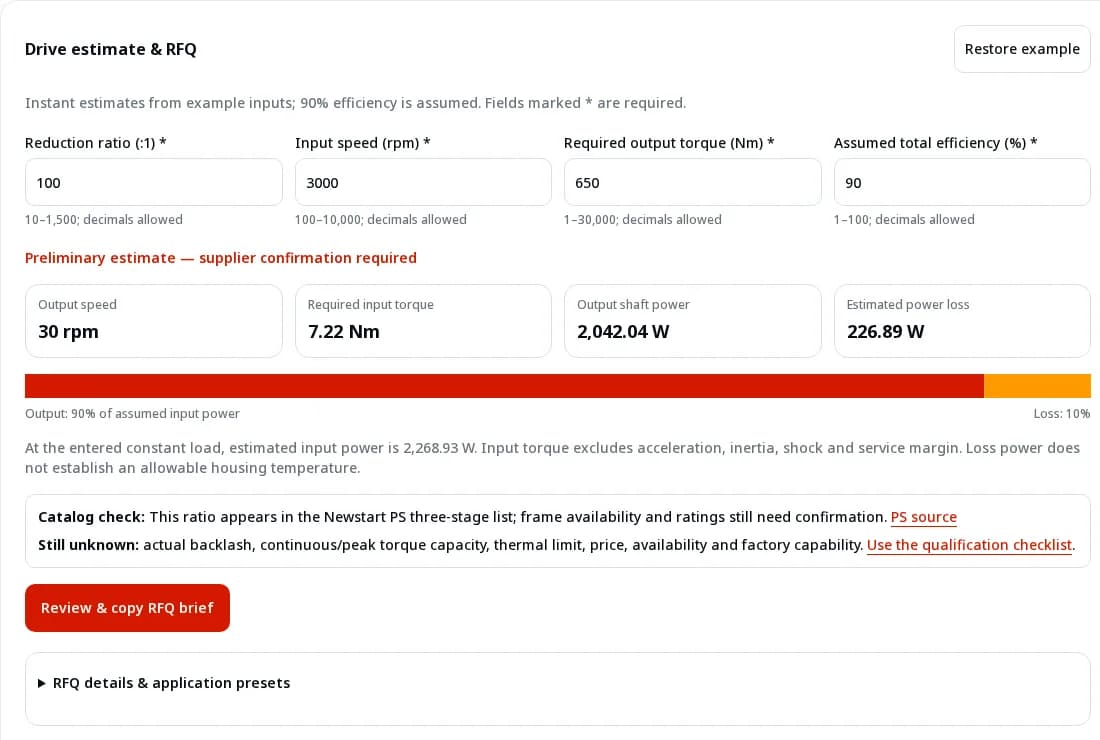
Default example: 100:1, 3,000 rpm, 650 Nm, eta = 0.90 gives 30 rpm output, 7.22 Nm input torque, 2,042.04 W output and 226.89 W estimated loss. Reproduce it with “Restore example” above. No calibrated sourcing score or verified supplier match is assigned.
ISO 1328-1 classifies individual gear flank tolerances. It does not provide a one-to-one mapping from a tooth grade to assembled gearbox arcminutes. Treat complete gearbox backlash and lost motion as separate test requirements.
Illustrative rigid serial-train play model
J_out ≈ J3 + J2/i3 + J1/(i2 × i3)
Here each J is angular play at that stage’s own output; i2 and i3 are the downstream reductions. Assuming J1 = J2 = J3 = 3 arcmin, i2 = 5 and i3 = 4 gives 3 + 0.75 + 0.15 = 3.90 arcmin. This is an explicit teaching derivation, not a claim about a particular supplier.
The output-stage share in this example is 3/3.90 ≈ 77%, not a universal 85–92%. Changing the clearances or ratios changes the share. Compliance, hysteresis, preload, bearings, couplings and measurement setup are excluded. The tool does not calculate actual gearbox backlash from the target value.
For acceptance, agree the input lock, output test torque, temperature, run-in, directions, fixture and instrument uncertainty. Record both backlash and torsional stiffness where the application needs reversal accuracy. Lost motion and hysteresis reference.
For stages connected in series at the same operating point, eta_total = eta1 × eta2 × eta3. Three assumed 97% stages give 91.27% total; this is arithmetic, not a measured catalog rating. Actual total efficiency depends on the design and operating point.
| Total efficiency assumption | Input torque | Input power / loss |
|---|---|---|
| 90% | 7.22 Nm | 2,268.93 W / 226.89 W |
| 95% | 6.84 Nm | 2,149.51 W / 107.48 W |
| 100% — ideal boundary only | 6.5 Nm | 2,042.04 W / 0 W |
Do not select oil viscosity, seals, cooling or temperature limits from input rpm alone. Ask the manufacturer to approve the lubricant, fill, orientation and allowable housing temperature for your exact unit, ambient and duty. Continuous running and shock braking require different evidence from an intermittent indexing example.
The following is a proposed buyer checklist, not a universal standard-mandated inspection plan. Define sampling, acceptance limits and record retention in the purchase specification. Gear load calculations need the actual geometry, materials, duty and agreed safety basis. ISO 6336-1 scope.
| Gate | Ask the supplier for | Hold release when |
|---|---|---|
| Entity and quality system | Legal producing entity, plant address, certificate issuer/scope/expiry, subcontract controls. | The quoted entity and producing site cannot be reconciled. |
| Drawing and rating | Signed frame/ratio/stage drawing; continuous and peak torque/speed limits, shaft loads and motor interface. | Only a generic series brochure is offered. |
| Material and process | Agreed steel specification, heat-treatment records and traceable inspection. Approve any proposed material substitution. | An “equivalent” grade or fixed case depth is asserted without design approval. |
| First article | Agreed dimensions, backlash method/results, run-in and thermal data at the required conditions. | The test protocol or failed results remain unresolved. |
| Repeat production | Revision control, batch traceability, inspection plan, nonconformance handling and change notification. | The sample design or critical process changes without approval. |
IATF certification has an automotive context. Robotics, medical or AGV applications do not automatically imply that IATF 16949 or a particular PPAP level is required. Use the customer’s contractual quality requirements and verify the certificate scope rather than inferring a supplier tier from a logo or machine brand.
No verified transaction dataset is available here for price, MOQ, scrap rate, tooling cost or current lead time. Those values remain unknown until a dated supplier quote is returned. Avoid substituting regional averages or invented cost percentages.
| Line item | Required comparison basis | Current status |
|---|---|---|
| Gearbox unit price | Exact drawing revision, frame/ratio, backlash requirement, quantity band and currency. | Unknown — written quote required. |
| Tooling and setup | One-time engineering, patterns, fixtures, ownership and repeat-order charges. | Unknown — separate from unit price. |
| Inspection and spares | Included reports, sample acceptance, spare unit/parts scope and warranty terms. | Unknown — define the same scope for each bidder. |
| Packing and transport | Package weight/dimensions, delivery term and named place; route-specific freight quote. | Unknown — request a dated shipping estimate. |
| Sample milestone | Drawing freeze, material/tool readiness, sample test and customer approval dates. | Buyer deadline only until acknowledged. |
| Production milestone | Approval dependency, batch quantity, inspection, dispatch and arrival dates. | Buyer deadline only; distinguish factory dispatch from arrival. |
The tool measures both deadlines from order to expose an obvious conflict when production is requested before the sample. It does not model approval delays, shipping or capacity. A milestone plan should also state the lead-time trigger: order, payment, drawing freeze or sample approval.
| Risk | Consequence | Mitigation / alternative |
|---|---|---|
| Treating an estimate as a product rating | Under-sized teeth, bearings or motor; an unsuitable unit may still produce plausible numbers. | Require rated and peak-load evidence; add inertia and acceleration analysis. Compare a larger frame or different architecture. |
| Treating low backlash as complete positioning accuracy | Elastic twist, hysteresis and installation error may dominate under load. | Test the assembled axis in reversal; compare output feedback or an alternate reducer architecture. |
| Running continuously using an intermittent rating | Excess temperature, lubricant problems and reduced service life. | Ask for continuous thermal data at the installed duty. Compare cooling, a larger frame or a helical reducer. |
| Awarding on a partial price or optimistic deadline | Unbudgeted tooling, inspection, freight or approval delays. | Normalize quote scope and milestone triggers; qualify a second supplier if continuity matters. |
A lifting, human-contact or other safety-critical application needs its own system risk assessment, braking and acceptance process. This page has no information to approve that system.
These are hypothetical calculations using the same model as the tool, not customer case histories or verified factory results. Apply the matching preset under RFQ details to reproduce them.
Inputs: 100:1, 3000 rpm, 650 Nm, assumed eta 90%.
30 rpm output · 7.22 Nm input · 226.89 W loss
Ask for bidirectional assembled backlash and stiffness data. Add acceleration torque and the indexing duty timeline before motor selection.
Inputs: 64:1, 2800 rpm, 1200 Nm, assumed eta 89%.
43.75 rpm output · 21.07 Nm input · 679.5 W loss
Supply wheel overhung loads, braking events and shock peaks. Compare a wheel-drive unit if shaft bearings cannot carry the load.
Inputs: 125:1, 1450 rpm, 1500 Nm, assumed eta 90%.
11.6 rpm output · 13.33 Nm input · 202.46 W loss
Request continuous thermal and bearing ratings at the actual ambient temperature. Compare an industrial helical reducer if positioning accuracy is secondary.
No. Stage count describes cascaded reduction sections. Total reduction is the product of their individual ratios: 5 × 5 × 4 gives 100:1 in the illustrative layout below.
It calculates input torque from required output torque, ratio and assumed efficiency. It has no tooth geometry, bearing or frame data, so the manufacturer must confirm continuous and peak ratings.
The available ratio per stage depends on the design. The cited PS table even lists 64:1 in both stage groups. Compare exact drawings and ratings rather than ordering by stage count alone.
It is an editable teaching assumption. Replace it with data for the actual model, ratio, speed, load and temperature. The 100% boundary is only an ideal lossless comparison.
This guide links Newstart PS and WANSHSIN WAT documentation as starting points. The examples are non-exhaustive, not rankings or independently audited approvals. Confirm the producing entity and current model availability.
No direct conversion is used here. ISO 1328-1 concerns individual tooth flanks. Specify complete gearbox backlash with agreed torque, temperature, fixture and measurement method.
Do not infer that requirement from the application name. IATF concerns automotive supply-chain certification; ask the customer which quality-system scope and submission documents apply to this contract.
No. Identify the process owner, approved subcontractor, batch traceability, inspection and change-control arrangements. Accept or reject the actual controls against the agreed purchase requirements.
Attach the motor drawing, output interface, continuous and peak torque with duration, duty timeline, ambient and mounting conditions, shaft loads, and acceptance protocol. The brief explicitly lists these gaps.
No. Quantities and deadlines are buyer requests. Obtain a dated quote naming currency, tooling, MOQ, inspection scope, delivery term and named place, plus a route-specific freight estimate.
No. It estimates mechanical power not delivered at the output at one operating point. Allowable temperature needs manufacturer thermal data and a test at the actual duty, cooling, lubricant and mounting conditions.
Restore the example or correct the stated range. The ranges are user-interface limits, not manufacturing limits. Email the application requirements if your design falls outside them; do not replace them with a misleading number.
Sources reviewed 2026-10-28. Standards links support only the cited public scope; no full standards compliance audit is claimed. Manufacturer pages and catalogs can change. Request the exact revision with the quotation; retain a copy with the accepted configuration.
Stage/ratio table checked in the indexed official page; live retrieval timed out during this review. A catalog claim is not a test result or stock commitment.
Catalog access and published China contact location; legal entity and producing site require verification.
WAT performance table, Standard Backlash P2, Stage 3 row. Use the exact frame/ratio row when requesting confirmation.
Catalog access and published Hunan contact location. This does not establish the origin of every offered part.
Torque, ratio and efficiency relationship; mechanical permissible torque remains a separate limit.
Public scope and terminology. It does not specify assembled gearbox backlash.
Public abstract and applicability; no universal material, safety factor or complete gearbox approval is inferred.
Explains why lost motion and torsional behavior need an agreed measurement method.
Automotive certification context; customer scope and current requirements must be checked separately.
Unresolved for any future purchase: actual factory audit results, model-specific efficiency map, materials and heat treatment, assembled backlash at your conditions, continuous thermal capacity, price, MOQ and dated delivery. The tool deliberately leaves these open; the next step is a signed technical response and sample qualification.
Use the generated RFQ above to preserve your inputs. Attach the motor and output drawings and ask for a model-specific response with the evidence gates in this guide. For an early discussion without complete inputs, use the inquiry options below.
Return to the estimate & RFQ toolInquiry Email