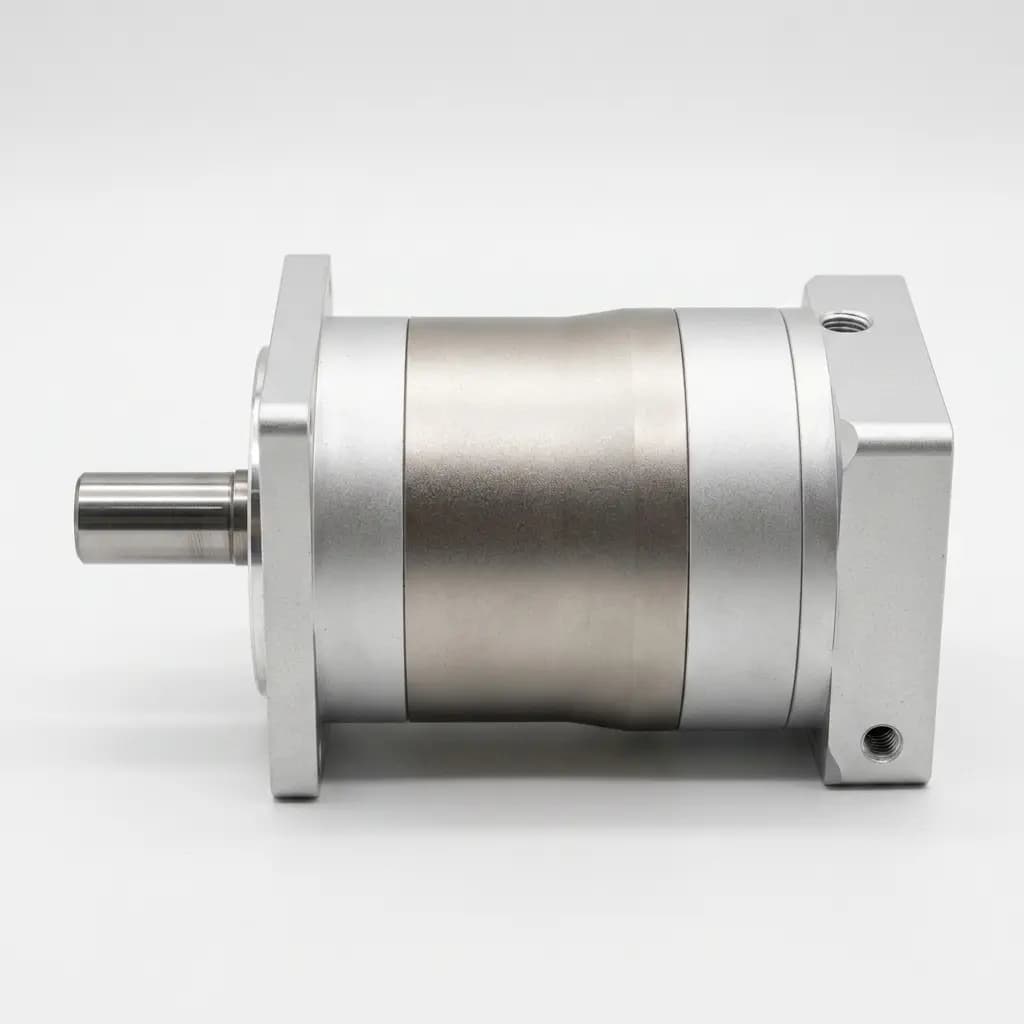
Decoding Planetary Gearbox Accuracy: True Backlash vs. Lost Motion
Stop sizing high-precision axes based on a single backlash number. Learn how to read hysteresis curves and calculate real-world lost motion before your machine fails in the field.
I review dozens of failed machine designs every year. The most common mistake I see from OEM engineering teams? Sizing a servo axis based on a single "backlash" number from a PDF catalog.
You find a gearbox with a "≤ 3 arc-min" rating, plug it into your CNC design, and expect the tool tip to hold exactly within that window. During commissioning, you run a dial indicator against the axis and find 8 to 10 arc-minutes of deviation under load. The machine chatters, settling times drag out, and the surface finish is rejected.
The problem isn't that the manufacturer lied about the backlash. The problem is that clearance backlash and dynamic positioning accuracy are two completely different things.
Clearance Backlash is Just a Gap
Catalog backlash is measured under basically zero load. The manufacturer locks the input shaft, applies a tiny 2% reversing torque to the output, and measures the slop.
This number only tells you the physical air gap between the gear teeth. That gap is necessary—without it, thermal expansion would cause the gears to bind, and the lubrication film would be squeezed out. But in a real application, your servo motor drives heavy loads, accelerates aggressively, and puts massive torsional stress on the output shaft.
Under load, that 3 arc-min physical gap is just the starting point of your error.
The Real Metric: Lost Motion
For an engineer, the only number that matters is Lost Motion. This is the total angular deflection at the output shaft when your actual operating torque is applied and reversed.
Lost motion consists of:
- Clearance Backlash (Deadband): The physical gap between gears.
- Torsional Deflection: The twisting of the sun gear, planet carrier, and output shaft under load. Steel bends.
- Bearing Yield: The microscopic movement of the internal bearings supporting the carrier.
If a gearbox has tight clearance but poor torsional rigidity, it will behave like a stiff spring. Your servo loop will constantly fight this elasticity, leading to resonance and hunting.
Reading the Torsional Hysteresis Curve
The only way to know how a gearbox will perform under load is to look at its Torsional Hysteresis Curve. If a supplier cannot provide this curve for a "high-precision" gearbox, walk away.
Torsional Hysteresis Curve (Torque vs. Angular Deflection)
The curve tells you exactly what happens under load. The flat horizontal section in the middle is the deadband (your catalog backlash). As torque increases, the curve slopes upward. That slope is the Torsional Stiffness (Nm/arc-min).
A cheap gearbox will have a very flat slope—meaning it twists easily. A premium gearbox has a steep slope. When you program your servo controller's error compensation matrix, you must use the total width of the curve at your specific operating torque, not the deadband at the origin.
Realistic Positioning Error Estimation
If you don't have the exact curve on hand, here is a practical rule of thumb I use for estimating actual lost motion based on the application's torque utilization.
| Application Type | Torque Utilization | Catalog Backlash | Est. Torsional Deflection | Total Real-World Lost Motion |
|---|---|---|---|---|
| Laser Cutting / Optical | 10% - 20% of Tn | ≤ 3 arc-min | + 1 arc-min | ~ 4 arc-min |
| High-speed Packaging | 40% - 60% of Tn | ≤ 3 arc-min | + 3 arc-min | ~ 6 arc-min |
| Heavy CNC Interpolation | 80% - 100% of Tn | ≤ 3 arc-min | + 5 to 7 arc-min | ~ 8 to 10 arc-min |
Note: Calculations assume standard series planetary rigidity. HDF or specific high-rigidity models will halve the torsional deflection component.
Field Example: CNC Router Z-axis Replacement
Last year I worked with a customer in Dongguan building CNC wood routers. They had been running a Taiwanese 90-frame spur planetary gearbox on the Z-axis with a 2 kW Yaskawa Sigma-7 servo. The catalog backlash was ≤ 5 arc-min. For wood routing at moderate feed rates, this was fine for two years.
Then their end customer in Vietnam switched from MDF to hardwood. Cutting forces tripled. The Z-axis started producing visible step marks on plunge cuts.
Their first reaction was to replace the gearbox with a ≤ 1 arc-min unit from a premium European brand. That would have cost them USD 1,200 per axis — four times their existing BOM.
I asked them to run a dial indicator test at their actual peak cutting torque. The measured lost motion was 11 arc-min. Their problem was not clearance — it was torsional wind-up under the heavier load. We swapped them to a 120-frame standard series unit (≤ 3 arc-min clearance, but with 3x the torsional stiffness of the 90-frame). Cost per axis: USD 380. Step marks disappeared on the first test cut.
The fix was not tighter backlash. The fix was more steel.
The Stiffness Hierarchy
Not all "low-backlash" gearboxes are created equal. Torsional stiffness varies dramatically across frame sizes, even when the clearance spec is identical.
Torsional Stiffness by Frame Size (Typical Single-Stage, ≤ 3 arc-min)
A 60mm frame with ≤ 3 arc-min backlash has roughly 3 Nm/arc-min of stiffness. A 155mm frame — same backlash class — has 18 Nm/arc-min. Six times stiffer. Under a 50 Nm reversing torque, the 60mm would add 16 arc-min of elastic deflection. The 155mm would add less than 3 arc-min.
Same spec on the catalog. Completely different machine behavior.
Designing for Reality
You cannot magically erase the physics of elasticity. But you can manage it.
- Calculate peak reversing torque. Know exactly how much force your gearbox sees during an emergency stop or aggressive acceleration profile.
- Ask for the stiffness spec. If the stiffness is low (e.g., < 5 Nm/arc-min for a 90-frame gearbox), expect severe wind-up under load regardless of the "≤ 3 arc-min" sticker on the box.
- Upsize for rigidity, not just strength. We frequently bump an axis from a 90mm frame to a 120mm frame. Not because the 90mm isn't strong enough, but because the 120mm provides the torsional stiffness needed to keep lost motion inside the tolerance window.
- Request the hysteresis curve at your operating torque. Any manufacturer serious about precision will provide this. If they can only give you a single backlash number measured at 2% torque, their "precision" claim is marketing, not engineering.
Don't buy a spec. Buy the curve.
More Posts
Low-Backlash Reducer Update: Zero-Backlash AMR Gate
Use this 2026-W23 low-backlash reducer update to compare planetary, cycloidal, and AMR drive substitutes across US, EU, and APAC sourcing risks.

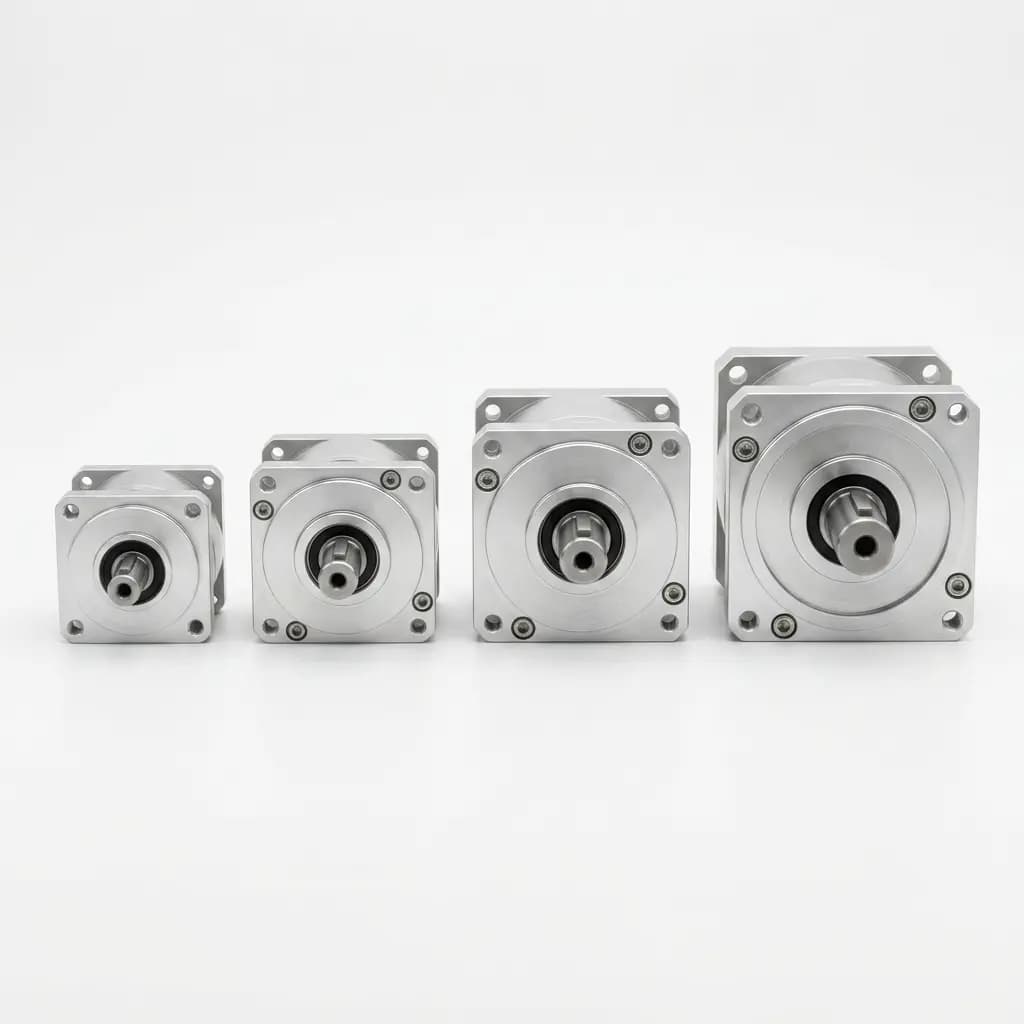
How to Safely Second-Source and Cross-Reference Low Backlash Planetary Gearboxes
Validate dimensions, torque, stiffness, duty cycle, and supplier risk before approving a second-source low backlash planetary gearbox replacement in 2026.
Flange Output vs. Shaft Output Planetary Gearboxes: A Sourcing and Engineering Guide
Compare flange output and shaft output planetary gearboxes. Learn when to pay the premium for flange mounts based on torsional stiffness, space, and BOM costs.