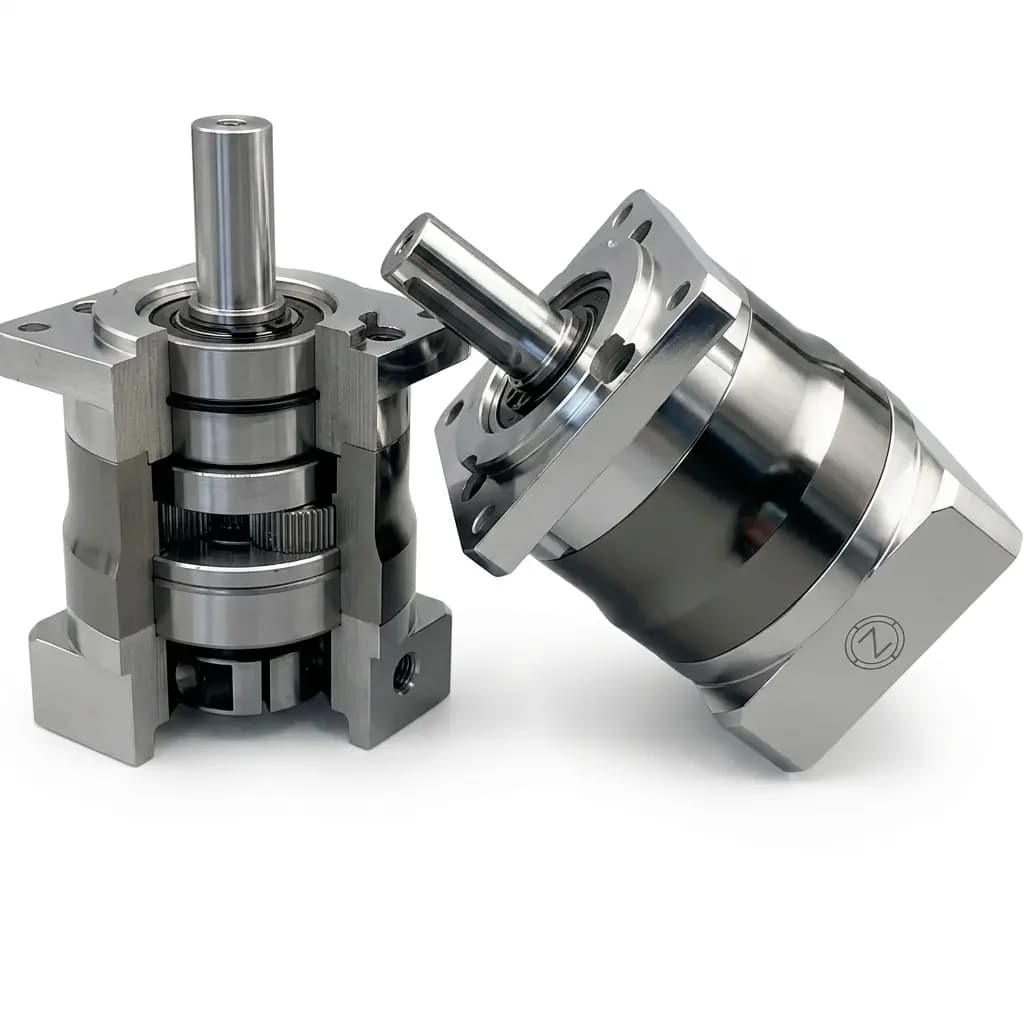
Backlash in Planetary Gearboxes: What 1 Arcmin Really Means
A practical explanation of backlash classes and where they matter in automation equipment.
Backlash is the angular clearance that appears when an axis reverses direction. Buyers usually notice it as overshoot, delayed settling, or unstable repeatability during indexing tasks.
What 1 arcmin means on an actual axis
1 arcmin = 1/60 degree = about 0.0002909 rad.
Approximate linear lost motion at a radius r is:
linear error ≈ r × angle(rad)
Example:
- At 50 mm radius: about 0.0145 mm
- At 100 mm radius: about 0.0291 mm
This is a simplified geometric estimate. Real axis error also depends on stiffness, control tuning, and load variation.
Why 1 arcmin appears in so many RFQs
For servo indexing and positioning applications, tighter backlash can reduce accumulated positioning error and shorten compensation effort on the machine side.
Where tight backlash matters, and where it is overkill
| Application type | Sensitivity to backlash | Procurement priority |
|---|---|---|
| Servo indexing table | High | Prioritize backlash + stiffness data |
| Vision-guided pick-and-place | High | Validate repeatability under cycle load |
| Conveyor or transfer axis | Medium | Balance backlash with lifecycle cost |
| General speed reduction | Low to medium | Prioritize reliability and lead time |
This quick filter helps buyers avoid over-specifying expensive backlash classes where they are not needed.
Why two "1 arcmin" gearboxes can behave differently
Two gearboxes with the same backlash class can still behave differently in production because of:
- Torsional stiffness differences under dynamic load
- Bearing support and overhung-load sensitivity
- Thermal expansion under long-cycle operation
- Manufacturing consistency across batches
For procurement, this means you should evaluate backlash as one item in a multi-parameter decision set.
Additional checks that change real machine behavior
- Rated and peak torque across your target ratio
- Torsional stiffness under dynamic load
- Flange and shaft interface tolerance
- Duty cycle and thermal behavior
Ask for backlash data in a comparable format
In RFQ and technical review, request:
- Backlash class value (for example, class window)
- Measurement condition (input/output lock method, test torque)
- Inspection stage (factory final test vs sampling)
- Any preload or run-in condition affecting measured value
If measurement conditions are missing, values from different suppliers are not comparable.
Frequent sourcing mistake
A common mistake is selecting by the smallest backlash number only. In real production, axis stability often depends equally on stiffness and thermal consistency. Use backlash as a gate, then compare dynamic and lifecycle behavior.
RFQ checklist buyers can copy
Before requesting quotation, include:
- Axis function and positioning expectation
- Target backlash class and measurement condition request
- Rated and peak torque with duty cycle
- Motor model and mounting interface details
- Expected annual quantity and delivery cadence
Send operating context with the backlash target. Without operating context, you get marketing values; with context, you get engineering-usable proposals.
Author

Categories
More Posts
Servo Motor to Gearbox Matching Checklist for OEM Teams
The minimum data package needed to avoid fit and performance mismatch in gearbox selection.
Drop-in Replacement Workflow for Imported Planetary Gearboxes
A step-by-step method to evaluate replacement feasibility versus incumbent international brands.
How to Write an RFQ for Low Backlash Gearboxes (So You Get a Usable Quote)
A practical RFQ structure for OEM buyers that reduces back-and-forth and improves quote accuracy.