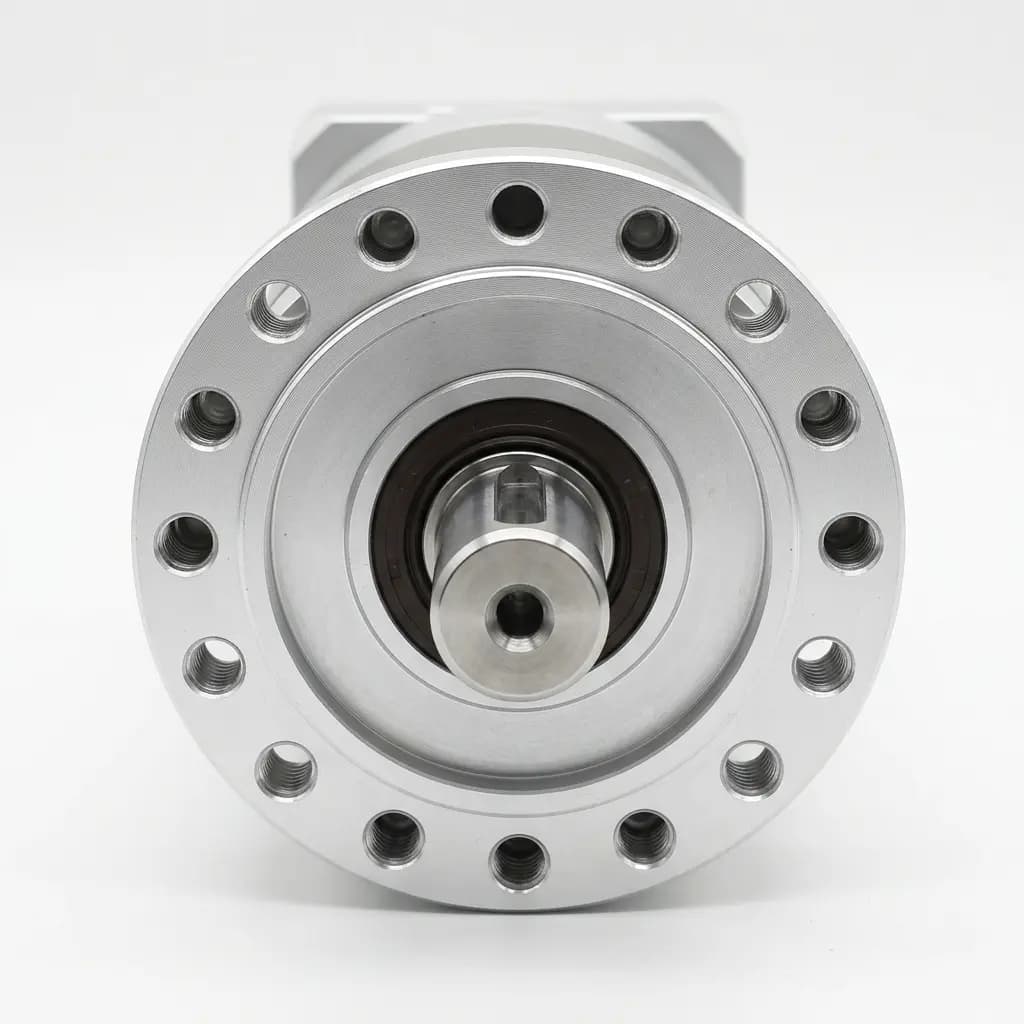
Helical vs. Spur Planetary Gearboxes: Engineering Trade-offs
An objective analysis of Helical vs. Spur gear technologies. Discover when to pay the premium for helical gears and when spur gears are the smarter, more reliable choice.
When specifying a planetary reducer, one of the first architectural choices is whether to use a Spur or Helical gear train.
If you talk to a European premium brand rep, they will insist helical gears are the only acceptable choice for precision automation. If you talk to an Asian mass-production factory, they will push spur gears as the ultimate cost-effective solution.
The truth? Neither is universally better. Paying a 40% premium for a helical gearbox in an AGV drive wheel is a total waste of your BOM budget. Conversely, putting a spur gearbox on a high-end CNC laser cutter will ruin your surface finish.
The Physics: Impact vs. Progressive Engagement
The fundamental difference lies in the Contact Ratio—the average number of tooth pairs actively transmitting load at any given moment.
Tooth Engagement: Spur vs. Helical
Spur Gears have teeth cut parallel to the axis of rotation. When two spur gears mesh, the entire face width of the tooth makes contact at the exact same moment. It is a sudden, high-impact transfer of force.
Helical Gears have teeth cut at a helix angle. Contact starts at one edge of the tooth and progressively sweeps across the face as it rotates. Multiple teeth are engaged simultaneously, resulting in a continuous, smooth transfer of power.
The Engineering Trade-off Matrix
Here is how that physical difference translates into real-world machine behavior.
| Metric | Spur Gearbox | Helical Gearbox | Why it happens |
|---|---|---|---|
| NVH (Noise & Vibration) | Moderate to High (Whine) | Very Low & Smooth | Spur impact causes micro-vibrations and torque ripple. Helical sweeps smoothly, dropping noise by 5-10 dB. |
| Torque Density | Baseline | +20% to 30% Higher | Helical's angled teeth create a longer actual tooth face, and multiple teeth share the load. |
| Internal Axial Thrust | Zero | Extremely High | Angled helical teeth wedge against each other, pushing the planet carrier sideways. Spur forces are purely radial. |
| Bearing Complexity | Simple (Deep Groove) | Complex (Angular Contact) | Helical requires heavy, high-friction bearings to counter the thrust forces. |
| High-Speed Efficiency | Excellent (Low Friction) | Good (Higher Heat) | The heavy thrust bearings in helical units generate more heat during continuous high-speed running. |
| Manufacturing Cost | $ (Baseline) | $$$ (+30% to 60%) | Cutting internal helical ring gears requires expensive 5-axis gear shaping and complex heat treatment. |
Field Example: AGV Wheel Drive in Suzhou
A logistics automation company in Suzhou was building AMR units (autonomous mobile robots) for a major 3PL warehouse. Their mechanical engineer spec'd helical planetary gearboxes because the datasheet promised "ultra-low noise" — important, he assumed, for a warehouse where human pickers work alongside the robots.
Each AMR had two drive wheels. The helical gearbox was USD 320 per unit. For a fleet of 200 AMRs, that was USD 128,000 in gearbox costs alone.
I asked them to measure the actual noise profile of the AMR in their warehouse. The dominant noise sources were: the wheel rubber against epoxy floor (62 dB), the BLDC motor controller PWM switching (58 dB), and the conveyor belts running overhead (71 dB). The spur gearbox whine at their operating speed? 54 dB — completely masked by the environment.
We switched them to a spur planetary unit at USD 180 per axis. Same frame size, same backlash class, same ratio. Total savings: USD 56,000 across the fleet. No single warehouse worker noticed the difference.
The helical gearbox also had another hidden cost: because the angular-contact thrust bearings have higher friction, battery consumption on each AMR increased by roughly 4% compared to the spur unit's low-friction deep groove bearings. Over an 8-hour shift, that is 15-20 minutes of additional charging time per robot per day.
Cost Anatomy: What You Actually Pay For
The price difference between spur and helical is not just "gear teeth." Here is a breakdown of where the helical premium goes:
Cost Breakdown: Where the Helical Premium Goes (90mm Frame, Single-Stage)
The two biggest cost drivers are:
- Gear machining — helical internal ring gears require 5-axis shaping and much more complex heat treatment to prevent helix distortion. That alone nearly doubles the gear cost.
- Thrust bearings — angular-contact bearings cost 80% more than deep-groove ball bearings, and the assembly requires precise preload adjustment.
When to Specify Spur Gearboxes
Spur is the undisputed workhorse of general automation. If your application falls into these categories, do not pay the helical premium:
- Packaging and Conveyors: The factory ambient noise will easily mask the spur gear whine.
- AGVs and Mobile Robots: Spur gearboxes use low-friction ball bearings, meaning less battery drain and no axial bearing heat buildup during continuous rolling.
- Pick-and-Place Actuators: Standard positioning tasks do not care about micro-torque ripples.
- Cost-Competitive Machinery: Whenever the BOM cost dictates the success of your platform in the market.
When to Specify Helical Gearboxes
You must absorb the higher cost and use a helical gearbox when your machine dictates one of these three requirements:
- Ultra-low NVH is Mandatory: Medical imaging beds, clean-room laboratory automation, or printing presses where vibration causes immediate product defects.
- Micro-Surface Finish is Critical: 5-axis CNC mills, laser cutters, and grinding machines. The torque ripple from a spur gear will literally print "chatter marks" into your machined metal or cut path. Helical is required for perfect path interpolation.
- Extreme Envelope Constraints: When you absolutely must push 250 Nm of torque but the mechanical envelope physically limits you to a 90mm frame size, the 20-30% higher torque density of helical gears will save the design.
Quick Decision Flow
Before you freeze your gearbox architecture, run through this checklist:
- Is my dominant noise source the gearbox, or the motor/environment? → If environment, use spur.
- Does my surface finish or path quality require zero torque ripple? → If yes, use helical.
- Am I running continuous S1 duty on battery power? → If yes, spur's lower friction wins.
- Does the mechanical envelope absolutely demand maximum torque density? → If yes, use helical.
- Is my BOM cost a competitive differentiator? → If yes, use spur.
If you answer "spur" to three or more of these, the helical premium is not justified. Spend the savings on a stiffer frame or better bearings instead.
More Posts
Low-Backlash Reducer Update: EU Machinery Regulation Gap & US Import Signals
Assess precision reducer sourcing risks for 2026-W25, focusing on the EU 2023/1230 harmonised standards gap, US import volume spikes, and motor-reducer compatibility checks.

Thermal Management and Duty Cycle Sizing: The Hidden Killers
A gearbox rated for 50Nm will destroy itself at 30Nm if you run it 24/7 without cooling. Here is how to properly size reducers for S1 continuous vs S5 intermittent duty.
The Hidden Cost of Over-Specifying Backlash: A Procurement Guide
A practical July 2026 checklist for deciding when <=1 arc-min backlash is justified, when 3-8 arc-min is enough, and what evidence procurement should request before approving a premium gearbox.