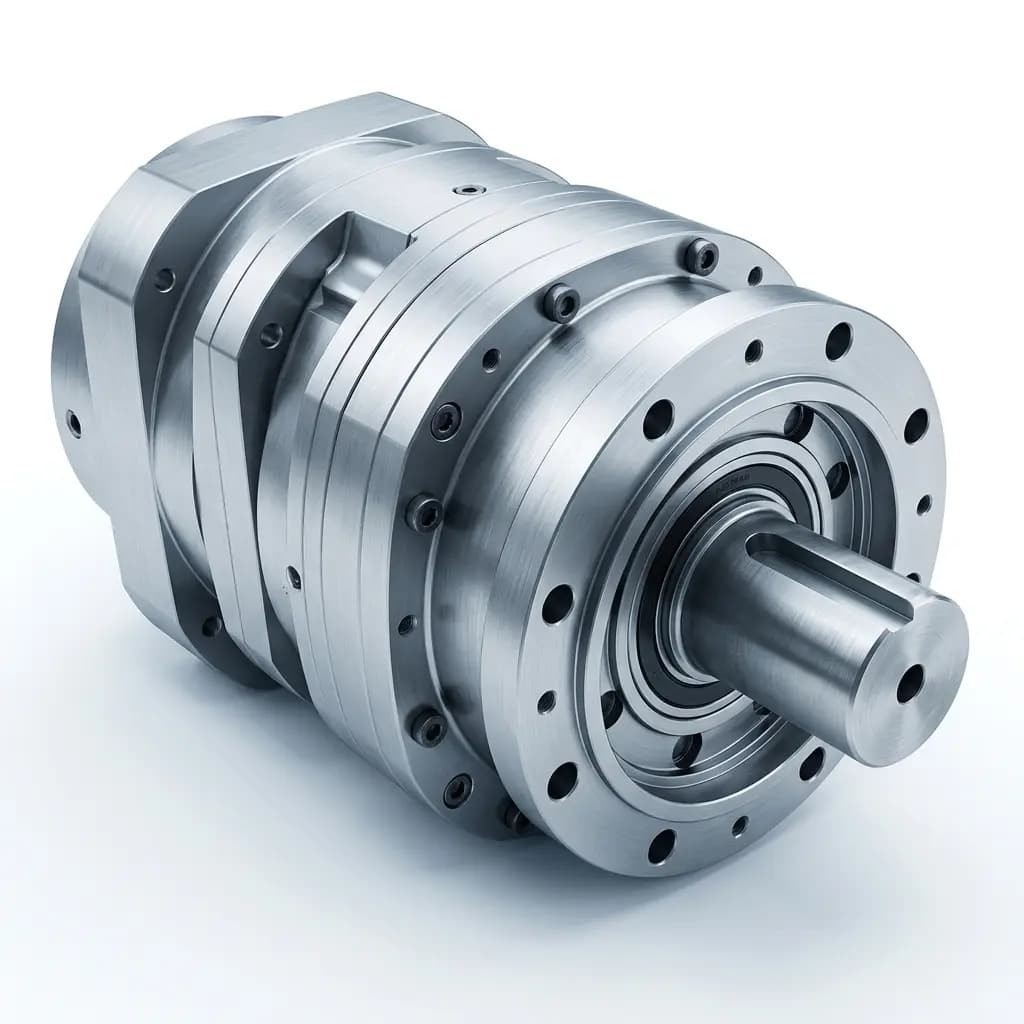
Thermal Management and Duty Cycle Sizing: The Hidden Killers
A gearbox rated for 50Nm will destroy itself at 30Nm if you run it 24/7 without cooling. Here is how to properly size reducers for S1 continuous vs S5 intermittent duty.
When a planetary gearbox comes back from the field locked up, the autopsy almost never points to a sudden mechanical fracture from over-torque. In 90% of the teardowns I perform, the root cause is entirely thermal.
Gearboxes are highly efficient, but they are still mechanical systems. A planetary unit with 95% efficiency converts 5% of your input mechanical power directly into heat. If your machine's cycle doesn't allow that heat to dissipate, internal temperatures will climb until the grease breaks down, the seals crack, and the bearings seize.
The most dangerous mistake I see from OEM teams is sizing a gearbox purely by its mechanical torque limit while completely ignoring the time domain of the application.
The Illusion of the Nominal Torque Spec
It happens constantly: An engineer selects a motor with 5 Nm of nominal torque, pairs it with a 10:1 ratio, and buys a gearbox rated for 50 Nm. They assume they are perfectly safe.
But a gearbox's "nominal torque" rating is a mechanical fatigue limit. It guarantees the gear teeth won't snap under that load. It does not guarantee the gearbox can run at that load continuously at 3000 RPM without melting.
To size a drivetrain correctly, you must classify the duty cycle into one of two IEC categories: S5 (Intermittent) or S1 (Continuous).
S1 Continuous vs. S5 Intermittent Duty
Thermal Accumulation: S1 vs S5 Duty Cycles
S5 Intermittent Periodic Duty
This is standard servo-driven automation: Pick-and-place robots, indexing tables, and CNC tool changers. The axis accelerates aggressively, moves for half a second, decelerates, and stops.
Because the gearbox gets frequent dwell times (pauses) where zero heat is generated, it can dissipate the heat into the machine frame. If the active running time is less than 60% of the total cycle time, and any single run lasts under 20 minutes, you are in S5 territory. Here, you size for mechanical limits (peak torque and stiffness).
S1 Continuous Duty
This is the profile for conveyor belts, web tensioners, printing press rollers, and spindle drives. The axis spins constantly for hours or days.
In S1 duty, there is no dwell time. The heat from gear friction, bearing churning, and rotary seals accumulates constantly. In S1 applications, sizing is governed entirely by thermal limits. If you drop a compact, high-precision servo gearbox into an S1 application, it will burn up—even if you are only running at 30% of its rated mechanical torque.
Field Case: Conveyor Drive Burnout in Guangzhou
A packaging equipment manufacturer in Guangzhou contacted me after their third gearbox warranty claim in six months. They were running a 90-frame planetary on a bottle labeling conveyor — 1.5 kW Delta servo, 10:1 ratio, belt speed 0.8 m/s. Continuous duty, 16 hours per day, 6 days a week.
Their gearbox selection logic: Motor outputs 4.8 Nm, times 10:1 ratio = 48 Nm at output. The gearbox was rated for 80 Nm nominal. They had a 67% safety margin. On paper, it looked bulletproof.
In reality, after 3 months of running, the grease inside had turned to black paste. The output seal had hardened and cracked. Internal bearing clearance had tripled. The housing surface temperature was hitting 85°C during summer shifts.
The root cause: their 90-frame gearbox had a rated nominal input speed (n1N) of 3000 RPM for intermittent duty, but only 2000 RPM for continuous thermal operation. They were running at 2800 RPM — above the S1 thermal limit. The mechanical capacity was fine. The thermal capacity was not.
We replaced it with a 120-frame unit from the same product family. The n1N for S1 duty at 120mm is 3500 RPM. Same ratio, same motor. Housing temperature dropped to 52°C. No failures since.
The 120-frame unit cost USD 85 more. The three warranty replacements and two days of line downtime had cost them over USD 4,000.
The Anatomy of Thermal Failure
Here is exactly what happens inside a gearbox that overheats. This sequence takes weeks or months, but it is predictable and preventable.
Thermal Failure Cascade Timeline
Every step in this cascade is driven by heat, not by mechanical overload. The gear teeth never break. They just slowly grind themselves to death after the lubrication fails.
The Ambient Derating Reality
Standard gearbox thermal limits assume the unit is mounted in a factory running at 20°C (68°F), bolted to a massive steel frame acting as a heatsink.
If your machine is going into an unconditioned foundry, a tropical climate, or inside a sealed electrical cabinet, the thermal delta drops. The gearbox loses its ability to shed heat into the air.
When ambient temperatures rise, you must physically derate the nominal torque and speed capacity of the gearbox using this matrix:
| Ambient Temperature | Thermal Derating Factor | Practical S1 Output Capacity | Common Environment |
|---|---|---|---|
| 20°C (Standard) | 1.00 | 100% of Nominal Limit | Air-conditioned factory |
| 30°C (Warm Shop) | 0.85 | 85% of Nominal Limit | Typical open factory floor |
| 40°C (Hot Climate) | 0.70 | 70% of Nominal Limit | Southeast Asia, Middle East, unconditioned |
| 50°C (Near Oven) | 0.55 | 55% of Nominal Limit | Adjacent to heat treatment furnace |
If your application is 40°C and S1 continuous, a gearbox rated for 100 Nm thermally can now only safely transmit 70 Nm. You must upsize to the next frame size.
Most of the machines we supply to Southeast Asian and Middle Eastern markets fall into the 35-45°C ambient range. I apply a 0.75 derating factor by default for any customer in these regions. It adds USD 30-80 to the gearbox cost. It eliminates the USD 2,000+ cost of a field failure, airfreight replacement, and production downtime.
How to Prevent Thermal Catastrophe
- Verify the "Nominal Input Speed" (n1N). Datasheets list both Nominal and Maximum input speeds. The nominal speed is the continuous thermal limit. Never attempt to run continuously at the "Maximum" speed rating—that is strictly for sub-second bursts during S5 duty.
- Bolt it to a Heatsink. Gearboxes shed heat through conduction into the motor flange and the machine frame. Do not mount a high-duty gearbox on a thin, non-metallic bracket or isolate it with vibration pads unless you have actively calculated the thermal path.
- Switch to Fluid Grease for S1. Standard heavy grease channels (pushes away from the gears) at high continuous speeds, leaving teeth running dry. If you are designing for continuous duty, specify fluid grease or an oil-bath design so the lubricant constantly flows back into the mesh to extract heat.
- Monitor housing temperature during validation. Stick a thermocouple to the housing during your 48-hour burn-in. If it stabilizes above 70°C, you have a problem. If it is still climbing after 4 hours, you have a serious problem.
Stop looking only at the torque row on the datasheet. If you respect the thermal limits, the mechanics will take care of themselves.
Author

Categories
More Posts
Low-Backlash Reducer Update: Zero-Backlash AMR Gate
Use this 2026-W23 low-backlash reducer update to compare planetary, cycloidal, and AMR drive substitutes across US, EU, and APAC sourcing risks.
The Hidden Cost of Over-Specifying Backlash: A Procurement Guide
A practical July 2026 checklist for deciding when <=1 arc-min backlash is justified, when 3-8 arc-min is enough, and what evidence procurement should request before approving a premium gearbox.
2026-W21 Industrial Update: Documentation Proof Now Controls Low-Backlash Reducer Substitution Risk
2026-W21 low-backlash reducer update for US, EU, and APAC: HTS corrections, CBAM documentation, and servo/stepper retest gates to reduce substitution risk.