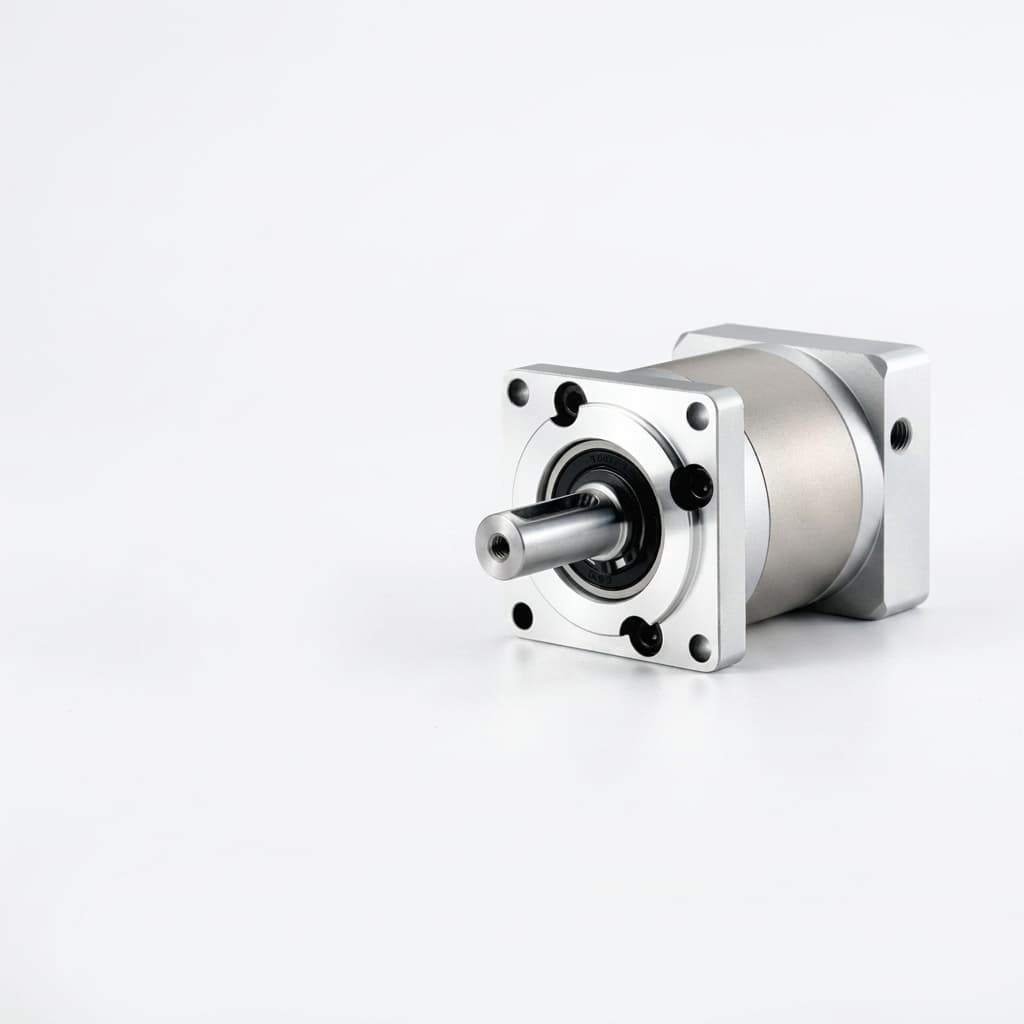
Smart Planetary Gearboxes in 2026: IoT Integration and Predictive Maintenance
Use this 2026 sourcing checklist to evaluate IoT-ready low backlash gearboxes, predictive maintenance data, protocol fit, and retrofit limits.
Smart planetary gearboxes are becoming a procurement topic because low backlash performance is no longer judged only by torque, ratio, torsional stiffness, and lost motion. In 2026, OEM teams also need to know whether a precision planetary gearbox can support condition monitoring, maintenance planning, and clean handoff to controls architecture.
Fast sourcing path: if you are replacing a passive reducer with an IoT-ready gearbox, start by confirming the mechanical fit in the cross-reference workflow, then send unresolved sensor, protocol, and duty-cycle questions to engineering review.
This article is written for mechanical engineers, controls engineers, maintenance leads, and procurement teams specifying low backlash gearboxes for CNC equipment, packaging machines, robotics, semiconductor automation, and other high-duty servo axes. It is not a claim that every gearbox now needs electronics. It is a decision framework for when embedded monitoring adds enough value to justify cost, validation work, and supplier qualification.
What Changed in 2026
For decades, gearbox selection was mostly a mechanical screening exercise: confirm ratio, acceleration torque, radial and axial loads, input speed, torsional stiffness, lubrication, mounting geometry, and backlash. If the gearbox survived the duty cycle and met the positioning budget, it was usually acceptable.
That is still the baseline. What changed is the cost of being surprised. In dense automated lines, a bearing or gear tooth failure can stop far more value than the gearbox itself. Maintenance teams therefore want earlier indicators of lubrication degradation, bearing wear, gear mesh anomalies, overload events, and temperature drift.
The practical shift is from "select a reducer and inspect it later" to "select a reducer that can provide usable condition data throughout its service life." A smart gearbox may include integrated accelerometers, temperature sensors, acoustic sensing, speed/load event logging, or an external sensor mounting provision with factory guidance. The right implementation depends on how quickly a fault must be detected and how much signal bandwidth the plant can actually use.
What Predictive Maintenance Can and Cannot Prove
Predictive maintenance (PdM) is useful when the monitored signal is close enough to the failure mode and when the team has a response plan. For a planetary gearbox, common indicators include vibration velocity, high-frequency acceleration, bearing fault frequencies, gear mesh sidebands, housing temperature, lubricant condition, overload counts, and trend deviation from a known-good baseline.
The strongest use cases are high-utilization axes where downtime is expensive and failures are not random. A continuously monitored gearbox can warn maintenance teams before a bearing defect becomes a seized stage or before lubrication loss damages the ring gear. The U.S. Department of Energy's O&M guidance is often cited for the broad business case: predictive maintenance programs can reduce maintenance costs and downtime when they are implemented with the right assets, sensors, and work processes.
The limitation is equally important. A sensorized gearbox does not automatically diagnose every fault, and an algorithm trained on one machine layout may not transfer cleanly to another. Cable routing, mounting stiffness, lubricant changes, motor-side vibration, resonance, washdown, and thermal gradients can all distort readings. For procurement, the question is not "does the gearbox have IoT?" but "which failure modes are measurable in our application, and what action will we take when the trend changes?"
Evolution of Gearbox Monitoring: Passive vs. Smart Predictive Maintenance
Avoid the Standards Trap
One issue deserves explicit correction because it affects purchasing documents: do not treat JIS B 1192 as a smart gearbox or AI-ready interface standard. JIS B 1192 covers ball screws, including vocabulary, nominal dimensions, accuracy measurement, and axial rigidity. It is not a planetary gearbox communication-interface mandate.
For low backlash gearboxes, the better compliance approach is to separate mechanical standards from monitoring and communication standards:
| Decision Area | What to Verify | Why It Matters for Smart Gearbox Sourcing |
|---|---|---|
| Mechanical rating | Ratio, rated torque, emergency torque, input speed, bearing loads, backlash, stiffness, lubricant, mounting geometry | The smart option still fails if the passive gearbox would be undersized. |
| Gear stress basis | Supplier design method, life calculation assumptions, and whether ISO 6336-style gear rating logic is relevant to the gear geometry | Prevents mistaking sensor data for mechanical life validation. |
| Vibration monitoring | Whether the supplier follows ISO 13373-style condition monitoring practices for vibration diagnostics | Gives maintenance teams a familiar language for trends, alarms, and diagnosis. |
| Sensor interface | IO-Link, analog, digital I/O, Ethernet, OPC UA, or gateway architecture | Determines whether plant controls can read the data without custom integration. |
| Data model | Raw waveform, RMS values, temperature, alarm states, event logs, bearing/mesh indicators | Determines whether the signal supports troubleshooting or only basic alarming. |
| Cybersecurity and ownership | Network segmentation, firmware update control, data retention, and cloud dependency | Avoids adding an unmanaged network node to production equipment. |
| Retrofit limits | Sensor mounting location, cable protection, calibration method, and baseline capture | Determines whether an existing gearbox can be monitored reliably. |
This distinction is important for global sourcing. Buyers can ask for "predictive-maintenance-ready" evidence without citing a non-applicable standard. The supplier response should show mechanical fit, monitoring method, interface specification, test data, and limitations.
Architecture Choices: IO-Link, Edge Gateways, and OPC UA
Adding sensors to a gearbox is only half the job. The engineering decision is how that data moves from the gearbox to the maintenance workflow.
IO-Link is often the practical choice for sensor-level integration. It works well when the gearbox or attached sensor module reports processed values such as temperature, vibration velocity, alarm state, and device diagnostics. It is usually easier to add to existing PLC architectures through an IO-Link master, but it is not intended for continuous high-frequency waveform streaming.
Edge gateway architectures fit many brownfield machines. The gearbox sensor output goes to a local monitoring module or industrial PC that handles sampling, frequency analysis, thresholds, and maintenance dashboard integration. This keeps high-bandwidth signal processing out of the PLC while still giving the machine team actionable status.
OPC UA and OPC UA over TSN are relevant when the plant is standardizing industrial data exchange across machines, lines, and enterprise systems. OPC UA provides an interoperability model, and TSN is used where deterministic networking matters. For gearbox monitoring, this route only makes sense if the plant has the edge or network infrastructure to use richer data.
Comparison: Traditional vs. Smart Planetary Gearboxes
Use this comparison during supplier shortlisting. The cost bands are planning ranges, not quotations; validate them against the exact ratio, frame size, sealing, cable, and environmental requirements.
| Feature Dimension | Traditional Low Backlash Gearbox | Smart Planetary Gearbox (IO-Link / Processed Data) | Smart Planetary Gearbox (Edge / OPC UA Data Path) |
|---|---|---|---|
| Primary specification focus | Mechanical torque, backlash, stiffness, geometry | Mechanical fit plus basic diagnostic data | Mechanical fit plus richer condition-monitoring data |
| Health monitoring | Manual inspection or external portable checks | Continuous temperature and processed vibration metrics | Trend analysis, event logs, spectral indicators, fleet comparison |
| Integration complexity | Mechanical only | Low to medium; needs IO-Link master or gateway | Medium to high; needs edge IPC, network rules, and data ownership plan |
| Predictive lead time | None unless external monitoring is added | Hours to days for thermal or vibration trend alerts | Days to weeks when baseline and analytics are mature |
| Best-fit assets | Low-cost or low-criticality axes | Production axes where early warning is useful but bandwidth needs are modest | High-value assets with expensive downtime and maintenance analytics support |
| Initial capital cost | Baseline | Often a moderate premium for sensors and gateway wiring | Higher premium for sensing, edge compute, integration, and validation |
| Main risk | Surprise failure and weak failure history | False alarms if thresholds are not tuned to duty cycle | Integration cost exceeds value if the plant cannot act on the data |
| Procurement evidence to request | Life rating, backlash, torque curves, mounting drawings | All traditional evidence plus sensor specification and alarm logic | All traditional evidence plus data model, sampling method, validation report, and cybersecurity notes |
The 2026 Smart Gearbox Sourcing Checklist
Use this checklist when qualifying a supplier for smart low backlash planetary gearboxes:
- Mechanical fit first: Confirm ratio, acceleration torque, output load, input speed, duty cycle, backlash, torsional stiffness, mounting, lubrication, and thermal margin before discussing sensors.
- Failure modes: Identify which failures matter most in your machine: carrier bearing wear, ring gear damage, lubrication breakdown, overload events, thermal drift, or mounting/coupling issues.
- Sensor placement: Ask whether sensors are embedded near the critical load path, externally mounted on the housing, or supplied as a retrofit kit with defined mounting instructions.
- Protocol compatibility: Confirm IO-Link, analog output, digital alarms, Ethernet, OPC UA, or gateway requirements against the PLC and maintenance system already used in the plant.
- Data usefulness: Require sample data fields, units, sampling rate, alarm thresholds, baseline method, and whether the supplier provides trend interpretation or only raw values.
- Environmental rating: Check cable protection, connector type, washdown exposure, oil mist, operating temperature, vibration shock, and whether electronics reduce the gearbox temperature limit.
- Validation evidence: Request a test report or field reference showing how the monitored signal changed before a known fault or maintenance event.
- Retrofit boundary: If upgrading an installed gearbox, document whether retrofit sensors are for trend awareness only or for formal predictive maintenance decisions.
Mid-project handoff: for a live RFQ, combine this checklist with your ratio, torque, motor, flange, and duty-cycle data, then submit the package through the contact page so mechanical and controls questions are reviewed together.
FAQ
Q: Do I need a smart gearbox if my servo drive already estimates load or vibration? A: Not always. Drive-side data can be valuable for overloads and system-level anomalies, but it is physically separated from the planetary stage. Gear mesh and bearing faults may be clearer when measured closer to the gearbox housing or bearing path. Use drive data for context and gearbox-mounted data for earlier local fault indicators.
Q: Can I retrofit an existing planetary gearbox to make it smart? A: Yes, but treat most retrofits as condition-awareness projects unless you have a controlled baseline. External accelerometers can be effective when mounted consistently and protected from cable damage, but they are easier to contaminate with motor, frame, and process vibration than factory-integrated sensing.
Q: Does a smart gearbox guarantee lower total cost of ownership? A: No. It reduces risk only when the monitored axis is critical, the data is reliable, alarms are tuned to the duty cycle, and the maintenance team acts before failure. For low-duty or easily replaceable axes, a passive gearbox with periodic inspection may still be the better purchase.
Q: What data should procurement request before approving a smart gearbox supplier? A: Request the mechanical datasheet, life assumptions, sensor list, protocol specification, sample data payload, alarm logic, environmental rating, wiring guide, calibration method, and at least one validation example. If the supplier cannot explain what each signal means, the IoT feature may not be useful.
Q: Are smart gearboxes physically larger than traditional gearboxes? A: Sometimes. Integrated electronics can fit within the same envelope on selected frames, but connector position, cable bend radius, sensor housing, and gateway wiring can still affect installation. Always check the 3D model and cable clearance, not just the flange dimensions.
Making the Transition
The right smart gearbox decision starts with the same engineering discipline as any low backlash gearbox decision: size the reducer correctly, validate the duty cycle, and protect the mechanical precision budget. Smart monitoring is an added layer, not a substitute for mechanical selection.
For global OEMs, the best 2026 sourcing language is specific rather than trendy: "provide low backlash planetary gearbox options with documented condition-monitoring interface, supported data fields, protocol compatibility, environmental limits, and validation evidence." That gives suppliers a measurable requirement and gives buyers a way to separate useful predictive maintenance from a cosmetic IoT label.
For next-step selection, review the available product families, collect supporting CAD and datasheet requirements from engineering resources, and route project-specific sensor or protocol questions to our engineering team.
Sources & References
- U.S. Department of Energy, Operations & Maintenance Best Practices: predictive maintenance program guidance
- IO-Link Community, IO-Link system description and IEC 61131-9 context
- OPC Foundation, OPC UA Field eXchange and TSN information
- ISO, ISO 13373-1 condition monitoring and diagnostics of machines by vibration
- Japanese Standards Association preview, JIS B 1192 ball screw scope
Author

Categories
More Posts
2026-W21 Industrial Update: Documentation Proof Now Controls Low-Backlash Reducer Substitution Risk
2026-W21 low-backlash reducer update for US, EU, and APAC: HTS corrections, CBAM documentation, and servo/stepper retest gates to reduce substitution risk.
Low-Backlash Reducer Update: EU Machinery Regulation Gap & US Import Signals
Assess precision reducer sourcing risks for 2026-W25, focusing on the EU 2023/1230 harmonised standards gap, US import volume spikes, and motor-reducer compatibility checks.
Thermal Management and Duty Cycle Sizing: The Hidden Killers
A gearbox rated for 50Nm will destroy itself at 30Nm if you run it 24/7 without cooling. Here is how to properly size reducers for S1 continuous vs S5 intermittent duty.