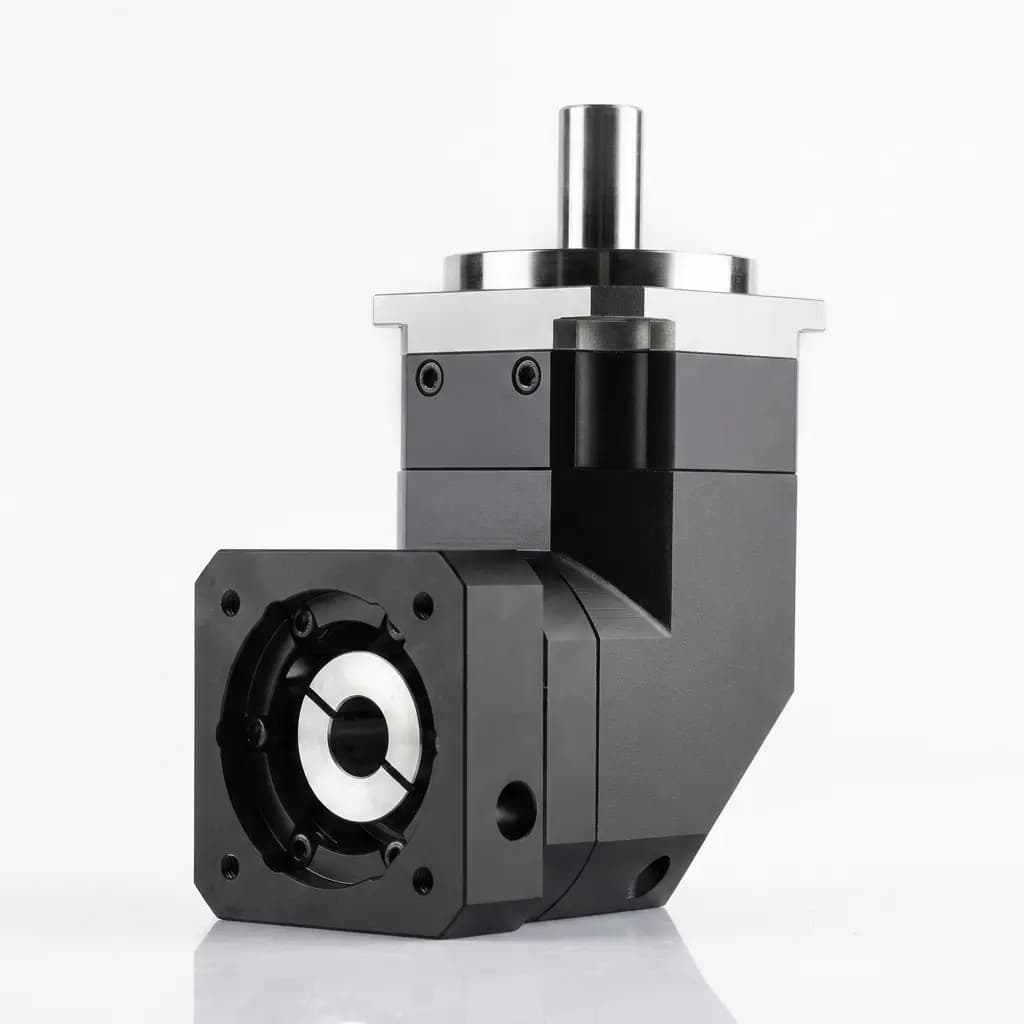
Right-angle vs Inline Planetary Gearbox: A Selection Guide for Machine Designers
How to choose between right-angle and inline architectures based on layout, stiffness, service access, and risk.
This choice is often made too early from CAD silhouette alone. In practice, transmission direction affects service access, bracket behavior, and long-term maintenance cost just as much as envelope fit.
First-pass decision matrix
| Criterion | Right-angle | Inline |
|---|---|---|
| Axial space constraint | Strong advantage | Usually weaker |
| Mechanical simplicity | Medium | Strong advantage |
| Service accessibility | Case-dependent | Usually better |
| Reuse of existing coaxial axis | Medium | Strong advantage |
| Compact routing flexibility | Strong advantage | Medium |
Use this matrix as a first filter, then validate with your real duty profile.
When right-angle usually wins
Right-angle units are usually preferred when:
- Axial space is limited
- Cable routing and motor position need separation
- Machine guarding requires low overall length
In compact cells, right-angle layouts can make the whole axis feasible without changing frame geometry.
When inline is usually the safer baseline
Inline units are often better when:
- The axis is naturally coaxial
- You want simpler mounting and alignment
- Future motor replacement should be straightforward
Inline structures reduce integration variables and are easier for first-time platform builds.
Checks before architecture freeze
Regardless of architecture, confirm:
- Output stiffness under peak acceleration
- Backlash class at operating temperature
- Bearing load direction and overhung-load limits
- Accessibility for maintenance and replacement
Many teams choose based on CAD envelope only, then discover service access conflicts during pilot build.
Integration risks teams catch too late
Right-angle risks to verify early:
- Housing orientation conflicts with cable tray and guards
- Unexpected overhung-load direction on output side
- Bracket stiffness issues under high acceleration
Inline risks to verify early:
- Excessive overall axis length after coupling and guard
- Poor maintenance access due to motor-reducer stack depth
- Resonance behavior in long, slender transmission paths
Cost comparison beyond unit price
Compare both options with total implementation cost:
- Adapter plate and bracket complexity
- Assembly time and alignment difficulty
- Rework probability if envelope assumptions change
Sometimes a slightly higher reducer price saves substantial commissioning time.
Pilot validation before release
Before locking architecture for mass production, run:
- Envelope fit check in full assembly context
- Dynamic run at representative speed and load
- Maintenance access simulation (tool clearance, replacement path)
- Vibration/noise check across target speed range
A short pilot validation cycle prevents large downstream rework.
Decision takeaway
Pick the architecture that keeps both commissioning and maintenance predictable. A compact design that blocks service access often becomes expensive after launch.
Author

Categories
More Posts
Servo Motor to Gearbox Matching Checklist for OEM Teams
The minimum data package needed to avoid fit and performance mismatch in gearbox selection.
How to Write an RFQ for Low Backlash Gearboxes (So You Get a Usable Quote)
A practical RFQ structure for OEM buyers that reduces back-and-forth and improves quote accuracy.
Backlash in Planetary Gearboxes: What 1 Arcmin Really Means
A practical explanation of backlash classes and where they matter in automation equipment.