RFQ planner · Published / reviewed
3 Stage Gearbox Supplier in China
Draft a gearbox RFQ, then check supplier evidence before shortlisting.
1. Four decisions before you shortlist
| Decision | Evidence and boundary | Next action |
|---|---|---|
| Start with a duty point, not a supplier badge | Speed, steady torque and power follow arithmetic; neither these numbers nor ISO 6336 certify an assembled drive. | Ask for continuous/peak rating, shaft-load limits and thermal evidence for the exact model. |
| Specify assembly backlash separately | ISO 1328-1 classifies gear flank deviations, not the complete drive reversal behavior. | Agree a bidirectional test torque, temperature and reporting method. |
| Treat delivery terms as obligations | ICC distinguishes DAP buyer import clearance from DDP seller import clearance; neither is a transit schedule. | Name the delivery point and importer arrangement; obtain a separate transport quote. |
| Keep unknown costs visible | No live supplier quotes, capacities or duty rates are available on this page. | Use a dated, like-for-like quote and a broker-confirmed import calculation. |
Evidence: ISO 6336-1:2019 — load capacity calculation scope; ISO 1328-1:2013 — gear flank tolerance classification; ICC Academy — DAP and DDP under Incoterms 2020. The actions in this guide are an editorial procurement method, not a mandatory universal inspection standard.
2. What the sizing model can establish
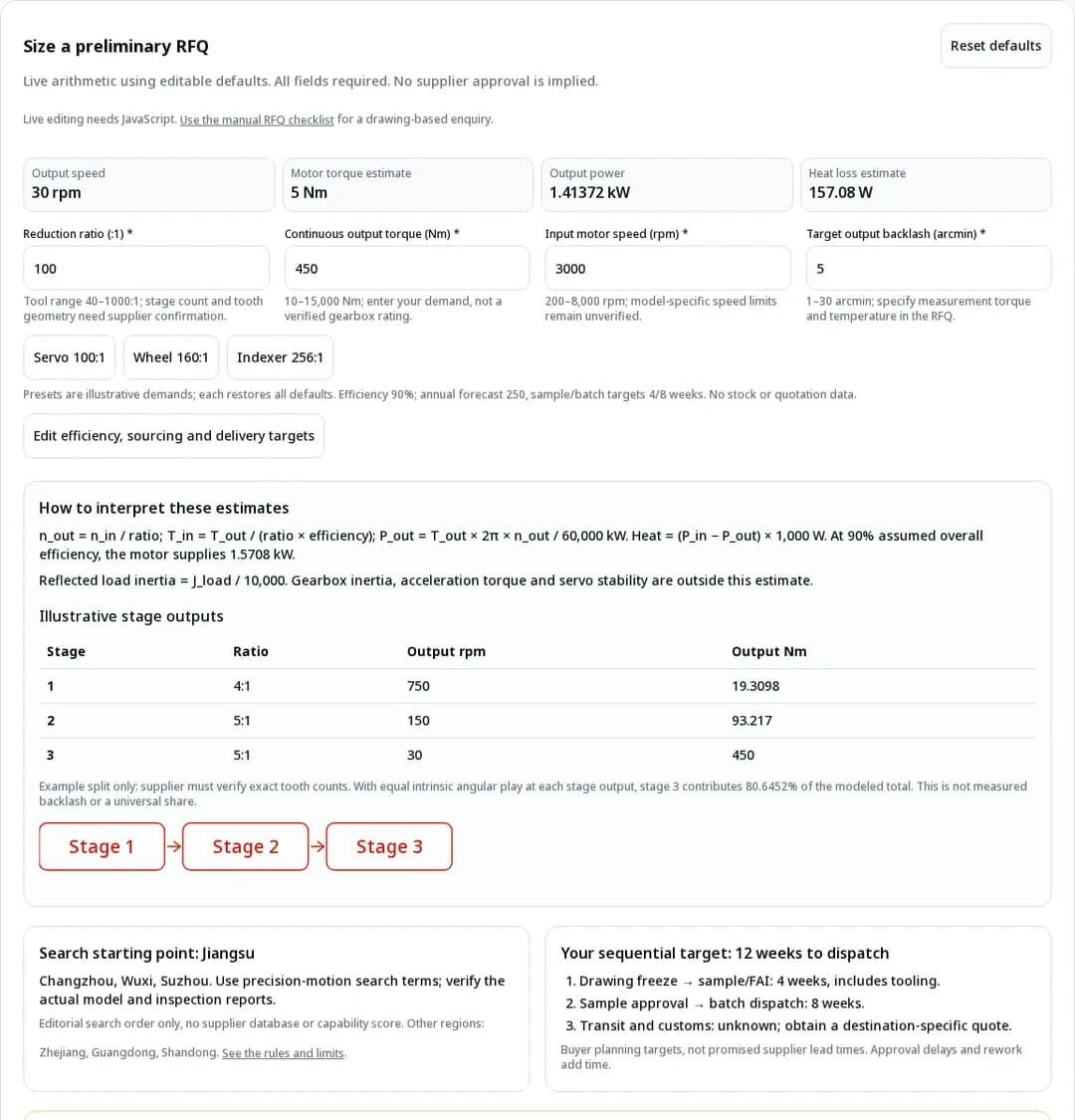
The tool assumes three serial reductions under a steady operating load. The ratio is the product of the three stage ratios. It assigns equal per-stage efficiencies whose product equals your overall efficiency input. Neither an integer-looking split nor the total ratio proves a manufacturable planetary design: tooth counts, planet spacing, interference and bearing packaging need a supplier drawing.
| Quantity | Result | Interpretation |
|---|---|---|
| Output speed | 30 rpm | 3,000 / 100 |
| Motor shaft torque | 5 Nm | 450 / (100 × 0.90), excludes acceleration |
| Output / input power | 1.413717 / 1.570796 kW | Shaft power at the entered duty point |
| Estimated loss | 157.080 W | Input minus output power; not a casing temperature |
| Reflected load inertia | J_load / 10,000 | Gearbox and rotor inertia remain separate |
Intermediate calculations retain full precision; displayed values are rounded. If your measured efficiency changes, update it before comparing suppliers. ISO 6336-1 sets out a specialist gear-load calculation scope; this arithmetic tool does not implement that strength calculation. ISO 6336-1:2019 — load capacity calculation scope.
3. Backlash, stiffness and acceptance are different questions
For angular clearance measured at each stage output, a simplified serial model gives j_out = j3 + j2/i3 + j1/(i2 × i3). With a 4×5×5 split and equal intrinsic stage clearances, the weights are 1, 0.2 and 0.04; stage 3 contributes 1/1.24 = 80.65%. This is a worked assumption, not a measured universal percentage.
Ask for reversal curves at an agreed test torque and stabilized temperature. Elastic windup under load is a stiffness issue; a zero-load backlash number does not describe it. Do not skip upstream gear inspection: high-speed stages still affect transmission error, vibration and loss. Gear flank tolerance classes need the actual geometry and standard edition; fixed micrometre limits without geometry are inadequate. ISO 1328-1:2013 — gear flank tolerance classification.
4. Where to search in China — and what geography cannot prove
No named supplier has been audited or ranked here. These regions are search prompts, with cities supplied as search terms. Their order is an editorial rule, not market-share research or a capability assessment. You can source from any region if the factory evidence is stronger.
| First matching condition | Starting search terms | Evidence still required |
|---|---|---|
| Output demand ≥ 2,000 Nm | Shandong: Zibo, Jinan; industrial drives | Duty-specific torque, shaft-load and thermal limits |
| Otherwise sample target ≤ 3 weeks | Guangdong: Dongguan, Foshan, Shenzhen; prototypes | Dated NPI plan and controlled drawing revision |
| Otherwise annual volume ≥ 500 and backlash > 5 arcmin | Zhejiang: Ningbo, Hangzhou, Taizhou; repeat batches | Capacity records, lot control and repeat inspections |
| Otherwise | Jiangsu: Changzhou, Wuxi, Suzhou; precision motion | Model-specific backlash and stiffness evidence |
The thresholds route the search; they do not establish any regional cost, accuracy or lead-time advantage. No fit percentage or GO approval is produced. Compare alternate regions and ask who actually manufactures the quoted gearbox.
5. Compare the contracting and manufacturing roles
| Supplier role | Possible benefit | Main control to agree |
|---|---|---|
| Integrated manufacturer | Direct access to design and production records | Verify the operations actually performed on site and the model owner. |
| Assembly OEM with sub-tier processes | May combine qualified gear, heat-treatment and assembly specialists | Require approved sub-tiers, incoming inspection and lot traceability. |
| Engineering exporter / integrator | May coordinate interfaces, documentation and logistics | Identify the factory, warranty counterparty, change authority and access to test records. |
These are commercial roles, not quality grades. Owning every machine does not prove capability, and outsourcing does not by itself disqualify a supplier. Verify legal-entity details, certificate scope, calibration status and a sample lot trail before making the shortlist.
6. Four evidence gates from RFQ to production release
| Gate | Request | Hold point |
|---|---|---|
| 1. Identity and process ownership | Order entity, actual factory address, certificate scope, sub-tier process map and warranty owner | Unclear manufacturer or unwillingness to trace a lot → hold the shortlist. |
| 2. Drawing and rating agreement | Exact ratio and topology; mounting drawing; continuous/peak torque, speed, duty cycle, shaft loads and life assumptions | Unresolved fit or duty requirement → no sample drawing release. |
| 3. First article (FAI) | Serial/lot records; material and heat treatment; critical dimensions; gear inspection; reversal and load/thermal tests | Record conditions, uncertainty and agreed acceptance limits. Unexplained exceptions → corrective action and retest. |
| 4. Repeat production release | Approved sample revision, inspection plan, change notification, packaging and lot acceptance records | Verify the first batch against approved evidence before changing payment or shipment milestones. |
Agree which tests are sample-based and which are required for each unit. A material inspection certificate cannot substitute for complete gearbox functional acceptance. Keep signed revisions and exception lists with the purchase order.
7. Validate heat, bearings and materials at the actual duty
Loss watts are a starting point for thermal review. ISO/TR 14179-1 describes a mineral-oil heat-balance rating under reference conditions including 25°C ambient and 95°C oil sump temperature. Those reference conditions do not establish a universal casing limit for a grease-filled servo unit. Obtain the selected model’s allowable temperatures and test at your mounting, ambient, speed, load and duty cycle. ISO/TR 14179-1:2001 — thermal capacity reference conditions.
Bearing rating life depends on capacity, equivalent load and speed. SKF describes the C/P life relationship and the effects of lubrication and contamination; the roller-bearing exponent is 10/3. That model does not guarantee complete gearbox life. Ask for the bearing identification, load spectrum and calculation assumptions, then agree validation appropriate to the intended service. SKF — rolling bearing life model and its limitations.
Specify material, case depth, hardness and lubricant against the supplier’s validated design and drawing. Do not prescribe one steel grade, pin tolerance or additive package for every size. A material substitution requires a controlled engineering review and revised acceptance evidence.
8. Compare landed cost with unknowns kept explicit
No current market price or tariff rate is verified here. The following is a hypothetical budgeting example, in USD for 100 technically equivalent units, to illustrate the comparison method. It is not a supplier quotation or an estimate of current freight.
| Cost item | Quote A assumption | Quote B assumption |
|---|---|---|
| 100 gearboxes | $15,000 | $18,000 |
| Tooling / NRE | $1,200 | $0 (included in unit price) |
| Agreed inspection | $600 | $300 |
| Freight and destination handling | $1,000 | $900 |
| Known-item subtotal | $17,800 ($178/unit) | $19,200 ($192/unit) |
| Import duty, taxes and broker fees | Unknown — confirm classification, value, origin, destination and date | Unknown — same basis required |
| Rework, downtime, spares and warranty recovery | Unknown — assess contractual exposure | Unknown — assess contractual exposure |
The $14/unit known-item difference does not establish the cheaper total-life option. Reconcile the delivery term so freight or duties are not counted twice. Ask the importer or customs broker for a dated classification and charge breakdown; keep recoverable tax separate. Obtain a new quote when quantities, currency or delivery dates change.
9. Agree delivery, schedule and packaging independently
For DAP, import clearance rests with the buyer; for DDP it rests with the seller, and the destination may restrict a foreign seller’s ability to perform it. Confirm the named place and importer arrangement. FOB/CIF apply to sea or inland-waterway delivery; discuss FCA with your forwarder for container or multimodal handover. The chosen term allocates obligations and risks, not transport duration. ICC Academy — DAP and DDP under Incoterms 2020.
The planner adds your sample target (drawing freeze to sample/FAI, including tooling) to your batch target (sample approval to dispatch). Approval delays, rework, transit and clearance remain additional unknowns. Ask for dated milestones with dependencies, named approvers and a recovery plan.
For packaging, agree corrosion protection compatible with the lubricant and seals, shaft/flange protection, moisture control and crate handling. Ask for packing photographs and an arrival inspection checklist. Choose the barrier, desiccant and crate treatment for the actual route and storage conditions rather than assuming every shipment needs the same specification.
10. Use a stop condition for each major risk
| Risk | What to do | Alternative if unresolved |
|---|---|---|
| Steady-state estimate mistaken for a rating | Obtain peak torque, emergency-stop and shaft-load validation. | Ask the supplier to resize or compare a different architecture. |
| Tight backlash but poor reversal stiffness | Agree the test torque and review the hysteresis curve. | Revise the assembly/interface or use a validated precision model. |
| Assumed efficiency hides a heat problem | Request measured loss/temperature at the intended duty. | Derate speed or torque, change the cooling/installation, or select another model. |
| Low unit price hides tooling or rejected-batch costs | Compare the same configuration, acceptance plan and warranty responsibility. | Retain an alternate source until equivalent evidence is available. |
| Region or certificate used as proof of suitability | Trace model-specific records to the actual factory and revision. | Hold the shortlist and audit another candidate. |
11. Three reproducible planning scenarios
These are hypothetical calculations, not customer installations, supplier quotes or endurance-test results. Reproduce them with the tool presets; all use an illustrative 90% overall efficiency.
Servo cell
Inputs: 100:1; 450 Nm; 3,000 rpm.
Estimate: 30 rpm output; 5 Nm motor torque; 157.08 W loss.
Next: Request reversal stiffness and validate cycle acceleration.
Wheel drive
Inputs: 160:1; 1,200 Nm; 2,500 rpm.
Estimate: 15.625 rpm output; 8.333333 Nm motor torque; 218.17 W loss.
Next: Add wheel radial loads, emergency-stop torque and duty spectrum before selecting bearings.
Indexer
Inputs: 256:1; 350 Nm; 3,000 rpm.
Estimate: 11.71875 rpm output; 1.519097 Nm motor torque; 47.72 W loss.
Next: Request positioning repeatability and stiffness at the actual payload; no accuracy guarantee follows from ratio.
12. Buyer questions before the next RFQ
Sizing and evidence
Does 100:1 mean the gearbox must have three stages?
No. Stage count depends on the gear topology, tooth counts and manufacturer design. The planner illustrates three serial stages; ask for the exact model drawing and ratio rather than inferring stage count from total ratio.
Is the calculated motor torque a motor selection?
It is steady-state shaft torque at the entered speed and assumed efficiency. Acceleration, peak loads, gearbox inertia, motor thermal limits and control stability remain to be checked. Complete the missing duty data in the RFQ before choosing a motor.
Does stage 3 always create 80–92% of output backlash?
No. In the simplified serial model, j_out = j3 + j2/i3 + j1/(i2×i3), with each j measured at its own stage output. At 4×5×5 and equal intrinsic stage play, the modeled stage-3 share is 80.65%. Different stage clearances, compliance and measurement loads change the result. Verify assembled reversal behavior.
Can an ISO gear accuracy grade prove an arcminute backlash rating?
No. ISO 1328-1 classifies deviations of individual gear tooth flanks. Assembly backlash also involves geometry, clearances and bearings. Request geometry-specific gear inspection plus a separate bidirectional assembly test with defined torque and temperature.
Supplier qualification
How do I distinguish a factory, assembler and exporter?
Ask which legal entity signs the order and which entity performs each process. Trace a sample lot through machining, heat treatment, gear inspection and final assembly. Controlled outsourcing is acceptable when responsibilities, records and corrective actions are documented.
Which China region should I start with?
The tool offers an editorial search prompt, not an audited regional capability ranking. It prioritizes Shandong for torque demands of at least 2,000 Nm; otherwise Guangdong for sample targets of at most three weeks; otherwise Zhejiang for at least 500 annual units and backlash above five arcminutes; otherwise Jiangsu. All regions remain eligible; accept suppliers on evidence.
Does ISO 9001 or IATF 16949 guarantee this gearbox performance?
A requested management-system certificate is not a model-specific torque, backlash or service-life guarantee. Verify issuer, scope and manufacturing site, then inspect the agreed technical evidence for the actual model and revision. PPAP is a customer-agreed submission package, not a substitute certificate.
What should the first-article package contain?
Agree the drawing revision, serial and material lot traceability, heat-treatment records, critical dimensions, gear inspection and bidirectional backlash method. Add load and thermal test conditions appropriate to the application, with acceptance limits and a named person who releases the sample.
Cost and delivery
What is the current price or MOQ for a 3-stage gearbox?
No current model-specific quote or MOQ is verified here. Ask suppliers for a dated quote covering frame size, exact ratio, continuous and peak ratings, backlash method, quantity, tooling, inspection, warranty, currency and delivery term. Compare only technically equivalent configurations.
Do the sample and batch weeks predict delivery?
They are buyer targets at separate milestones. The sample target starts at drawing freeze and includes tooling and FAI; the batch target starts after sample approval. Their sum is a sequential dispatch target. Transit, customs, rework and approval delays are unknown until separately agreed.
Who clears imports under DAP and DDP?
Under DAP the buyer handles import clearance and related costs; under DDP the seller takes those obligations, subject to the practical ability to clear imports at destination. Specify a named place and Incoterms 2020, and confirm the importer arrangement before accepting a quote. The term does not determine the transit time.
Can I use a fixed tariff percentage in landed cost?
Do not treat an undated generic rate as a landed-cost quote. The applicable classification, origin measures, valuation, destination and entry date must be confirmed by the importer or customs broker. Record the source and date and keep recoverable taxes separate from permanent costs.
Validation and next steps
Is 85°C a universal casing temperature limit?
No. ISO/TR 14179-1 describes a mineral-oil heat-balance rating with reference ambient and sump temperatures; it is not a universal casing limit for every grease-filled servo gearbox. Use the selected model lubricant, seals, installation and duty-specific temperature limits, supported by a thermal test.
Does a bearing L10 calculation guarantee 20,000 service hours?
No. A bearing rating-life estimate needs the actual bearing, equivalent load and relative speed, with lubrication and contamination considered. A gearbox service-life claim also needs the duty cycle and validation of other failure modes. This tool does not calculate bearing life or certify endurance.
What is the next step if the planner cannot handle my inputs?
Use the manual qualification table and send the target ratio, motor drawing, duty cycle, peak and continuous torque, shaft loads and quantity to the engineering inquiry address. Request a supplier calculation and a declared exception list rather than forcing out-of-range values into the tool.
13. Sources, review scope and unknowns
Sources reviewed on . ISO links below are public scope summaries, not access to every normative clause. They support the described scope; no clause-specific tolerances or certification are inferred. The SKF article explains a life model; the ICC article explains the selected trade obligations.
- ISO 1328-1:2013 — gear flank tolerance classification
- ISO 6336-1:2019 — load capacity calculation scope
- ISO/TR 14179-1:2001 — thermal capacity reference conditions
- SKF — rolling bearing life model and its limitations
- ICC Academy — DAP and DDP under Incoterms 2020
Published by LowBacklashGearbox. Review cycle: every six months, or sooner when source scope, formulas or supplier evidence change; next scheduled review by 9 May 2027. Send corrections through the engineering contact page.
Known: the tool formulas, example inputs, search-routing rules and source scope. Unknown: any supplier’s current stock, MOQ, prices, capability, lead time, certification status, exact model life and destination import charges. Search routing and qualification actions are editorial suggestions. No factory audit or customer trial is claimed.
For adjacent technical questions see the global 3-stage gearbox supplier & RFQ guide, the three-stage engineering guide and China manufacturing guide. This page’s goal is supplier qualification and RFQ preparation.
14. Send a complete requirement and ask for exceptions
Copy or download the RFQ above, add the motor drawing, duty cycle, peak and continuous loads, mounting orientation and named delivery place. Ask each candidate to mark every requirement confirmed, exception or not tested, with supporting records and a dated quote.