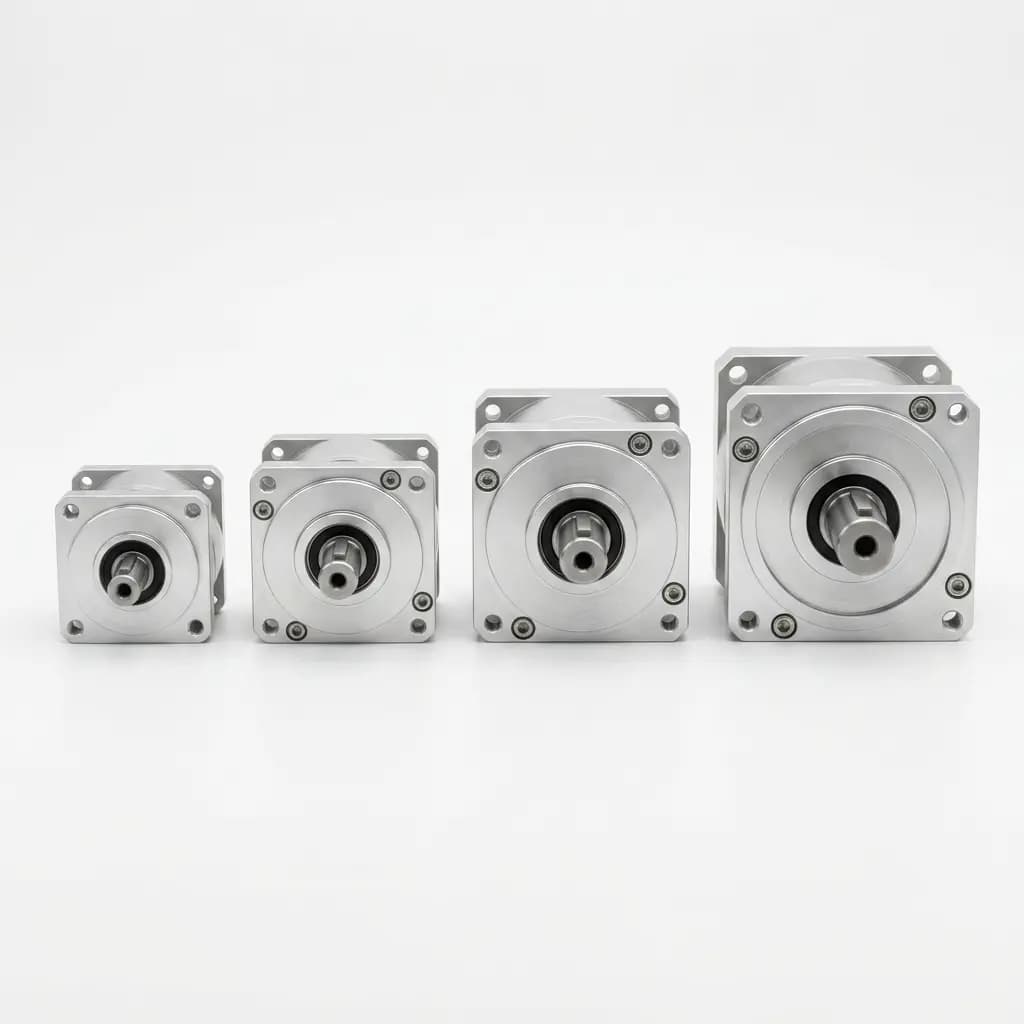
How to Safely Second-Source and Cross-Reference Low Backlash Planetary Gearboxes
Validate dimensions, torque, stiffness, duty cycle, and supplier risk before approving a second-source low backlash planetary gearbox replacement in 2026.
Procurement takeaway: A "drop-in replacement" based solely on mounting dimensions is a massive risk. To safely second-source a low backlash planetary gearbox, procurement and engineering must jointly validate three layers: physical dimensions (PCD, pilot, shaft), kinematic performance (backlash, stiffness, torque), and thermal capacity (duty cycle, lubrication).
Scope and limits, updated July 2026: This guide is written for OEM procurement teams, sourcing managers, and automation engineers tasked with diversifying their servo gearbox supply chain. The methodologies discussed apply to low backlash planetary gearboxes used in industrial automation, robotics, packaging, and CNC applications. It does not cover specialized cycloidal or strain-wave reducers, which require entirely different cross-referencing logic.
The Global Supply Chain Reality for Motion Control
In the high-stakes world of industrial automation, specifying a low backlash planetary gearbox has historically been a "set it and forget it" decision. An engineering team selects a premium brand—perhaps an Alpha Wittenstein, a Neugart, or an Apex Dynamics—qualifies it during the prototyping phase, and locks the exact part number into the Bill of Materials (BOM). For years, this strategy worked perfectly.
However, the supply chain landscape in 2026 continues to demonstrate the fragility of single-sourcing critical motion control components. Extended lead times, regional geopolitical disruptions, shipping bottlenecks, and aggressive cost-down mandates are forcing OEM procurement teams to find alternative suppliers. The directive from management is clear: find a second source that is cheaper and faster, but do not compromise the machine's performance or warranty. If the current part number is unclear, start with a structured gearbox cross-reference screening before asking suppliers for pricing.
This creates a fundamental tension between departments. Procurement wants flexibility and leverage. Engineering wants zero risk. When procurement brings an "equivalent" gearbox from an alternative supplier, engineering immediately (and rightfully) assumes it will fail, leak, or introduce positioning errors.
Bridging this gap requires moving away from the vague concept of a "drop-in replacement" and adopting a rigorous, objective cross-referencing framework. You cannot cross-reference a precision gearbox by merely comparing catalog model numbers. You must cross-reference the physics of the application.
Step 1: Dimensional Validation (The Mechanical Fit)
The term "drop-in replacement" is often misused. To a procurement specialist, it means the new gearbox bolts onto the machine without modifying the existing servo motor or the mounting bracket. To an engineer, it means the entire system dynamic remains unchanged. The first hurdle is always the physical geometry.
When cross-referencing, you must verify the exact measurements of both the input side (motor connection) and the output side (machine connection).
Output Side (Machine Connection):
- Pilot Diameter (Centering Collar): This is the machined raised lip on the front of the gearbox that centers it into the machine bulkhead. The tolerance here is critical (usually a g6 or h7 fit). If the alternative gearbox has a pilot that is even 0.05 mm too large, it will not fit into the existing machine bore.
- PCD (Pitch Circle Diameter): The bolt hole circle must match exactly. Pay attention to the thread size (e.g., M5 vs M6) and the depth of the tapped holes.
- Output Shaft Specifications: For shaft-output gearboxes, verify the shaft diameter, shaft length, and the keyway dimensions. For flange-output gearboxes (like ISO 9409-1), verify the dowel pin holes and threaded mounting holes.
- Overall Length: While the mounting face might match, an alternative gearbox might be longer. This can cause interference with protective covers, safety fencing, or adjacent moving components.
Input Side (Motor Connection): Servo motors are highly variable. Fanuc, Yaskawa, Siemens, and Allen-Bradley all have different motor flange dimensions, shaft lengths, and shaft diameters. When ordering a second-source gearbox, you cannot just specify the gearbox frame size; you must provide the exact motor part number so the manufacturer can supply the correct adapter plate and clamping hub. Do not assume that a "NEMA 34" designation is sufficient for a precision servo application. If you are still choosing the baseline architecture, compare the available low backlash gearbox product families before locking the interchange target.
Step 2: Performance and Precision Validation (The Engineering Fit)
Once the gearbox physically fits, the focus shifts to kinematic performance. This is where most cross-referencing attempts fail because different manufacturers use different testing methodologies and rating standards to publish their catalog numbers.
Understanding Torque Ratings: Never compare catalog torque ratings directly without reading the fine print. Manufacturer A might list "Nominal Torque" as the torque the gearbox can sustain for 20,000 hours at 100 RPM. Manufacturer B might list a higher number, but define it based on a 10,000-hour life at 50 RPM. Furthermore, you must cross-reference the Emergency Stop Torque (Maximum Acceleration Torque). In servo applications, the motor can spike to 300% of its continuous rating during a crash or aggressive deceleration. The replacement gearbox must survive these peaks without snapping a planet gear pin or permanently deforming the gear teeth.
Backlash vs. Torsional Stiffness: Procurement often looks at backlash as the sole measure of precision. If the original gearbox is rated at ≤3 arc-min, the buyer looks for a ≤3 arc-min alternative. However, backlash is only the clearance between the gear teeth under zero load. Under actual load, the entire gearbox frame, planet carrier, and output shaft will twist. This is measured as Torsional Stiffness (Nm/arc-min). A cheaply built replacement gearbox might have a ≤3 arc-min zero-load backlash, but a very low torsional stiffness. When the servo motor accelerates, the cheap gearbox winds up like a torsion spring, causing the tool-center point to overshoot, vibrate, and fail inspection. When cross-referencing for high-dynamic robotics or CNC axes, stiffness is often more critical than zero-load backlash.
Radial and Axial Bearing Loads: Planetary gearboxes don't just transmit torque; they also support the weight and tension of the driven load. If the gearbox is driving a heavy rack-and-pinion or a tensioned timing belt, it experiences massive radial loads pushing sideways on the output shaft. Premium gearboxes use oversized tapered roller bearings to handle this. Cheaper alternatives might use deep groove ball bearings to cut costs. The alternative might match the dimensions and the backlash, but the bearings will fail prematurely under high radial loads. Always verify the maximum allowable radial force and axial force at the specific output speed.
Step 3: Thermal Capacity and Duty Cycle (The Hidden Trap)
The most insidious failure mode for a cross-referenced gearbox is overheating. This occurs because the buyer successfully matched the dimensions, the torque, and the backlash, but failed to match the internal friction and thermal dissipation characteristics.
Industrial gearboxes are rated for specific duty cycles.
- S5 Duty (Intermittent): The gearbox runs for a few seconds, then rests, allowing it to cool down.
- S1 Duty (Continuous): The gearbox runs constantly at high speeds (e.g., printing presses, continuous conveyors).
Premium gearboxes designed for continuous S1 duty often feature specialized synthetic lubricants (like Klüber), optimized oil seal geometries to reduce friction, and internal designs that pump oil to critical friction points. If you replace an S1-rated premium gearbox with an alternative designed primarily for S5 intermittent duty, the new gearbox will rapidly overheat. The seals will bake and harden, the grease will liquefy and leak, and the gears will fail due to lack of lubrication.
Always verify the Nominal Input Speed and the Maximum Thermal Input Speed. If your servo motor consistently runs at 4,000 RPM, the alternative gearbox must be certified to shed heat at that continuous speed without exceeding its maximum housing temperature (typically around 90°C).
Evaluating Alternative Sourcing Trade-offs
When building your approved vendor list (AVL), categorize your alternative suppliers based on what compromises you are willing to accept. Use this matrix to guide discussions between purchasing and engineering.
| Parameter | Original Premium Brand | Valid Drop-in Alternative | Dangerous/Unacceptable Alternative |
|---|---|---|---|
| Mounting Pilot | Exact match (e.g., 90mm h7) | Exact match (90mm h7) | "Close enough" (e.g., 89.5mm or no tolerance spec) |
| Backlash | ≤ 3 arc-min | ≤ 3 arc-min | ≤ 5 arc-min (unless error budget allows) |
| Torsional Stiffness | 15 Nm/arc-min | ≥ 14 Nm/arc-min | Not listed / Supplier cannot provide data |
| Radial Bearing Load | 5,000 N (Tapered Roller) | 4,800 N (Tapered Roller) | 2,000 N (Ball Bearing) |
| Lubrication | Synthetic (Lifetime) | Synthetic (Lifetime) | Mineral Grease / Requires periodic maintenance |
| Service Factor Docs | Detailed sizing report | Application engineering review | "Just buy this size, it will work" |
The Step-by-Step Cross-Referencing Checklist
Do not approve a purchase order for a second-source servo gearbox until an engineer or a qualified motion control distributor has signed off on the following checklist.
- 1. Motor Interface Verification: Has the exact servo motor model number been provided to the new gearbox manufacturer? Is the adapter plate confirmed?
- 2. Output Geometry Check: Are the pilot diameter, PCD, and shaft dimensions a 1:1 match with the current 2D/3D CAD?
- 3. Ratio Confirmation: Is the exact gear ratio matched? (Note: Some manufacturers round a 9.8:1 ratio to "10:1". In interpolated multi-axis CNC, this will cause drift. Ensure the absolute mathematical ratio matches.)
- 4. Torque Rating Alignment: Does the alternative gearbox nominal torque exceed the continuous application torque, and does its emergency stop torque exceed the motor's peak stall torque?
- 5. Dynamic Precision Match: Have both zero-load backlash and torsional stiffness been validated against the machine's error budget?
- 6. Bearing Capacity Audit: If the axis uses belts, pulleys, or rack-and-pinions, does the alternative gearbox meet the required radial load rating at the specific lever arm distance?
- 7. Thermal Sanity Check: Is the application continuous (S1) or intermittent (S5)? Does the alternative gearbox support the average input speed without overheating?
Navigating the Politics of Second-Sourcing
Engineering teams are naturally defensive about BOM changes. They spent months tuning servo PID loops and qualifying the original premium gearbox. If procurement forces a change solely based on price, and the machine fails in the field, engineering bears the blame.
To successfully implement a second source, procurement must involve engineering early and present the alternative not just as a cost-saving, but as a technically validated equivalent. Use the checklist above to prove that due diligence was performed. Offer to purchase a prototype unit for a 30-day run-in test on a non-critical axis before rolling it out to the entire production line. For RFQ handoff, collect the motor model, current gearbox model, duty cycle, backlash target, and mounting constraints in one engineering resource request.
Frequently Asked Questions (FAQ)
Q: Can I cross-reference an inline planetary gearbox to a right-angle planetary gearbox to save space? A: Rarely without major redesigns. Right-angle gearboxes use spiral bevel gear input stages, which inherently have lower efficiency (usually 90-93% vs 97% for inline) and different inertia profiles. This change will require servo re-tuning, and the motor may need to be upsized to overcome the efficiency loss. Furthermore, the mounting geometry is entirely different.
Q: A competitor's interchange tool says their gearbox is a 100% drop-in. Should I trust it? A: Trust, but verify. Manufacturer interchange tools are excellent for finding dimensional matches (the flange and shaft). However, they rarely account for the specific loads, duty cycles, and bearing constraints of your specific machine. Always run the application numbers through the alternative supplier's sizing software to ensure it survives the dynamic loads.
Q: Why is the alternative gearbox significantly lighter than our current premium brand? A: Weight discrepancies are a major red flag. A significantly lighter gearbox usually indicates a smaller housing wall thickness, smaller bearings, or aluminum instead of steel in critical load-bearing areas. This translates directly to lower torsional stiffness and reduced crash survivability. Ask the supplier to explain the weight difference.
Q: We found a gearbox with identical specs, but it uses oil instead of grease. Is that a problem? A: It can be. Grease-lubricated gearboxes can be mounted in any orientation (horizontal, vertical up, vertical down). Oil-lubricated gearboxes often have specific mounting restrictions; if mounted incorrectly, the top bearing may starve for lubrication or oil may leak through the motor seal. Always specify the mounting orientation when cross-referencing.
Need Help Validating an Alternative Gearbox?
Cross-referencing precision motion control components is risky if you rely solely on catalog numbers. A slight mismatch in torsional stiffness or thermal capacity can lead to thousands of dollars in downtime, rejected parts, and damaged reputations.
Do not guess on your next supply chain pivot. Our application engineering team specializes in objective, data-driven gearbox cross-referencing. We analyze your load profile, motor specifications, and dimensional constraints to identify a safe, reliable drop-in replacement that meets your cost and lead-time goals.
Contact our engineering team or email your current gearbox part number to [email protected] for a comprehensive performance interchange report.
Sources & References
Author

Categories
More Posts
Specifying Low Backlash Gearboxes for AGV and AMR Wheel Drives
Choose low backlash gearboxes for AGV/AMR wheel drives with a 2026 checklist for radial loads, shock ratings, bearings, backlash, and RFQ review steps.
Thermal Management and Duty Cycle Sizing: The Hidden Killers
A gearbox rated for 50Nm will destroy itself at 30Nm if you run it 24/7 without cooling. Here is how to properly size reducers for S1 continuous vs S5 intermittent duty.
Smart Planetary Gearboxes in 2026: IoT Integration and Predictive Maintenance
Use this 2026 sourcing checklist to evaluate IoT-ready low backlash gearboxes, predictive maintenance data, protocol fit, and retrofit limits.